


As platform engineers, most of us have been there: wrestling with hundreds of Kubernetes clusters, trying to enforce consistent security, compliance, and operational policies, all while balancing developer velocity and team efficiency. If you’ve relied on open-source Kyverno, you already know how powerful policy-as-code can be for Kubernetes governance. You’ve probably enjoyed Kyverno’s native integration with Kubernetes, its YAML-first approach, and the fact that it empowers teams to codify guardrails directly in your clusters.
But as your infrastructure and engineering organization scale, the operational realities start to shift. What was sustainable for a handful of clusters becomes brittle and time-consuming at fleet scale. That’s where Nirmata’s AI-powered policy-as-code platform – including tools like the Remediator AI Agent, AI Copilot, and Command Line AI Platform Engineering Assistant come in. At its heart, this isn’t about replacing Kyverno; it’s about turning Kyverno into a scalable governance engine you can trust across your enterprise.
Kyverno OSS – Excellent Starting Point But Not The End Game
Open-source Kyverno is a fantastic foundation for Kubernetes policy as code. It lets you enforce security guards, compliance standards, and operational best practices right in the Kubernetes control plane. You can write policies that validate, mutate, generate, and even cleanup resources in real time, all in native Kubernetes YAML. Its tight integration with GitOps workflows means that your policy definitions live where your code does, in version control, creating transparency and auditability.
For early clusters and small teams, that’s often enough. You get a powerful policy engine that prevents misconfigurations, enforces resource limits, and integrates naturally into your CI/CD pipelines, without paying for anything. But as platform engineering demands grow, 3 gaps often emerge:
- Enterprise-grade reliability and support: Upgrading Kyverno across clusters, getting timely security patches, and aligning with organizational SLAs becomes a heavy lift.
- Multi-cluster visibility and governance: Kyverno runs locally in clusters, but it does not provide a centralized control plane for fleet-wide policy management.
- Operational overhead: Detecting violations is one thing – remediating them at scale is another altogether.
This is where an AI automated platform engineering offering starts to show its value.
Nirmata Enterprise for Kyverno – Kyverno Made Enterprise-Ready
Nirmata builds on Kyverno’s core strengths, and fills those gaps. Because Nirmata is the original creator and maintainer of Kyverno, the commercial experience is designed to be 100% compatible with your existing policies and workflows.
Centralized, Scalable Governance
Instead of managing independent Kyverno instances in every cluster, Nirmata offers a central control plane where you can enforce policies consistently across hundreds of clusters and environments. You get:
- Multi-cluster policy lifecycle management
- Centralized reporting and compliance dashboards
- Curated, enterprise-validated policy sets you can adopt out of the box
This translates into less operational friction and more consistent governance across your organization.
Enterprise-Grade Reliability
Open-source Kyverno updates don’t come with SLAs, but enterprise deployments often require predictable support and security guarantees. With Nirmata, you get:
- Long-term support with tested compatibility matrices
- SLAs for critical patches and CVE fixes
- Performance tuning and hardened distributions
That means no surprises when a crucial patch is needed or Kubernetes itself evolves.
Professional Support & Policy Best Practices
Instead of enlisting community forums or DIY experimentation, you can engage Nirmata’s support and professional services for:
- Curated policy sets aligned with security and operational best practices
- Training and workshops tailored to your team
- Direct help with writing and optimizing policies
| Features | Nirmata Enterprise Kyverno | Kyverno OSS |
|---|---|---|
| Release Support | 2 Years | Community |
| Support Channels | Email, Private Slack, Phone | Public Slack |
| Support SLAs | 24×7 support available | — |
| CVE / Security Fixes | 48 hours of disclosure | Typically in a few days |
| Feature Requests | Prioritized | Community |
| Kubernetes Compatibility | 2 Years | Community |
| Default Policy Sets | Validated | Community |
| Nirmata Control (nctl) | Included | — |
This is a game changer for organizations that want policy governance done right, and not just done.
AI-Powered Platform Engineering Assistance
Detecting violations is useful, but fixing them consistently, at scale, is where performance and efficiency skyrocket. That’s where Nirmata’s agentic AI capabilities make a huge difference.
Remediator AI Agent: From Alert to Fix
Traditional policy tools are great at telling you what’s wrong. But in large environments, the volume of policy violations can quickly overwhelm teams. The Remediator AI Agent doesn’t just detect violations, it:
- Understands the violation and its context
- Generates secure, policy-compliant remediation diffs
- Integrates with GitOps workflows to create pull requests automatically

That’s right, instead of manual ticketing, chasing developers, or hand-editing manifests, platform engineers can review AI-suggested fixes in pull requests and keep everything in your GitOps pipeline. This cuts mean time to remediate (MTTR) from days to minutes and lets your team focus on strategic engineering instead of repetitive toil.
Command Line AI: Your Policy-as-Code Copilot
For policy authoring and development workflows, Nirmata’s Command Line AI elevates the experience even further. From a local terminal, you can:
- Generate Kyverno policies from natural language prompts
- Create and run policy tests automatically
- Convert policies from other formats
- Get environment-specific recommendations
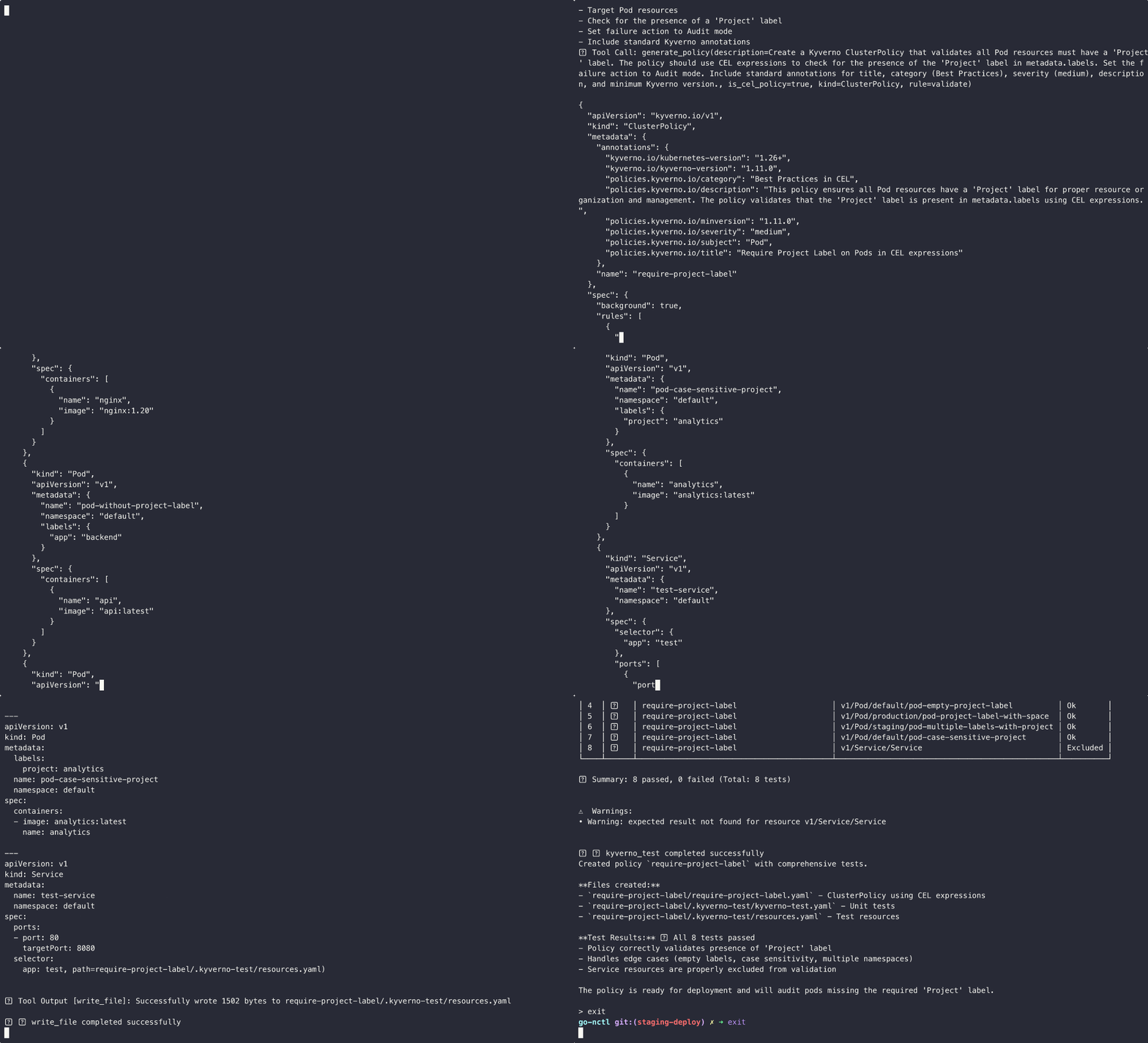
This speeds up policy development, reduces mistakes, and makes policy-as-code far more accessible, even for teams that don’t live in YAML all day.
When Does AI Platform Engineering Make Sense Over Kyverno
Open-source Kyverno works well when you’re early in your Kubernetes journey or operating a small number of clusters with limited policy scope. But as environments scale, misconfigurations quickly become the root cause of security incidents, downtime, and cost overruns. In fact, 23% of cloud security incidents are caused by misconfigurations, and platform teams often find themselves buried under a growing backlog of policy violations they can’t easily triage or remediate.
This is the tipping point where many teams realize the challenge isn’t writing policies, it’s operating policy-as-code at scale. False positives, policy drift across multi-cloud environments, oversized or mislabeled containers, and inconsistent enforcement across namespaces all create friction. Engineers spend hours debugging YAML or CEL, manually fixing violations, and chasing root causes instead of building platform capabilities.
Nirmata makes sense when you need to move from policy enforcement to policy automation. With AI-powered policy generation and remediation, Nirmata helps teams find, fix, and govern infrastructure automatically. The Policy-as-Code (PaC) Agent can generate and test policies using natural language, while the Remediator AI Agent goes a step further, generating verified fixes and opening pull requests with clear explanations. Instead of blocking deployments or slowing developers down, governance becomes proactive, automated, and developer-friendly.
The result is measurable business impact: up to 80% faster remediation, fewer violations, reduced downtime, improved cost accountability, and platform teams getting 150-200 engineering hours back over six months. Time that can be reinvested in innovation rather than firefighting.
| Use Case | Kyverno OSS | Nirmata AI Platform Engineering |
| Cluster Scale | Small or single cluster environments | Large, multi-cluster, multi-cloud fleets |
| Policy Volume | <10-15 policies, infrequent changes | 50+ policies with frequent updates |
| Policy Authoring | Manual YAML/CEL writing (2-4 hrs per policy) | AI-generated policies with ~80% time savings |
| Violation Remediation | Manual triage and fixes | AI-generated PRs with fixes + explanations |
| Violation Backlog | Grows linearly with scale | Automatically reduced through remediation |
| False Positives & Drift | Manually tuned and maintained | Continuously corrected and verified |
| Developer Experience | Risk of blocking deployments | Guardrails without slowing delivery |
| MTTR | Hours or days | Minutes to same-day resolution |
| Operational Overhead | High as environments scale | Significantly reduced through automation |
| Time to Production | Weeks for policy rollout | Days – sometimes minutes |
| Build vs Buy Reality | Engineering time diverted to governance | Platform teams focus on innovation |
A Practical Example
As one platform team evaluated their roadmap, they estimated they would need to write or modify 50+ policies over six months, at 2-4 hours per policy using Kyverno OSS. That’s 100-200 hours of engineering time, before accounting for remediation, testing, and ongoing maintenance.
By adopting Nirmata’s AI Platform Engineering Assistant:
- The Policy-as-Code Agent reduced policy creation and testing time by ~80%
- The Remediator AI Agent eliminated manual violation fixes by generating verified pull requests
- The team saved 150-200 engineering hours and cut weeks off their time-to-production
At that point, the decision wasn’t about features, it was about scale, speed, and focus.
Self-Service Control – AI as the Enabler, Not the Gatekeeper
One of the biggest promises of platform engineering is self-service, letting developers move fast while staying secure and compliant. In reality, many teams struggle to achieve this. Policies become blockers. Reviews become bottlenecks. Platform teams become ticket queues.
This is where the combination of policy-as-code + AI, fundamentally changes the equation.
With Nirmata, policies don’t just block, they guide. Developers get early feedback through CI/CD checks, clear explanations of why something violates policy, and in many cases, automatic fixes generated for them. Instead of submitting a ticket to the platform team, they get a pull request that shows exactly what needs to change.
For platform, security, and compliance teams, this enables:
- Guardrails that are always enforced
- Consistent standards across teams and clusters
- Fewer manual reviews and exceptions
- Less friction between platform and application teams
The result is a true self-service platform. One where teams can innovate at their own pace without breaking rules or increasing risk. Governance stops being a speed bump and starts becoming an accelerator.
Trusting AI in the Platform: Reliability, Safety & Control
When AI enters the platform engineering stack, the first question is rarely “is this powerful” – it’s “can we trust it? And that’s the right question to ask.
Platform Engineering AI isn’t consumer AI. It operates on production infrastructure, security controls, and compliance boundaries. Nirmata’s approach to AI is built around a simple principle: AI should operate inside well-defined guardrails, not outside of them.
That’s why Nirmata’s AI agents are grounded in policy-as-code. Policies define what is allowed, what is denied, and what good looks like. AI doesn’t invent new behavior, it works within those policy guardrails. When the Remediator AI Agent proposes a fix, it:
- Understands the context of the violation
- Generates a remediation that complies with existing policies
- Creates a pull request with a clear explanation
- Leaves the final decision in human hands
Nothing is silently changed in production. Every action is auditable, reviewable, and Git-tracked. This makes AI a force multiplier, not an uncontrolled actor. In practice, teams gain speed without sacrificing safety, and confidence instead of anxiety.
AI That Supports Platform Engineers
There’s a quiet concern that comes up any time AI is discussed, “is this going to replace us?”. The answer is emphatically no.
Nirmata’s AI Platform Engineering Assistant is designed to augment human expertise, not replace it. It handles the repetitive, low-leverage work:
- Writing boilerplate YAML or CEL
- Triage of repetitive policy violations
- Generating remediation diffs
- Creating pull requests and documentation
What it doesn’t do is make architectural decisions, define organizational standards, or understand business tradeoffs. Those remain firmly in the hands of platform engineers.
In practice, teams report that AI gives them back the time they need to:
- Design better platforms
- Improve developer experience
- Expand governance coverage without burnout
- Focus on higher-impact engineering work
Instead of replacing platform engineers, Nirmata’s AI helps them scale their impact, turning a small team into one that can support hundreds of clusters and thousands of workloads confidently.
The Real Business Impact
When you move from open-source Kyverno alone to Nirmata’s AI Platform Engineering Assistant, the impact goes beyond technical bells and whistles:
Improve Developer Velocity
Platform teams spend less time firefighting violations and more time enabling developers and building robust platform capabilities.
Strengthen Security and Compliance
Automated remediation, centralized reporting, and curated policy sets help you stay audit-ready and aligned with internal and external standards.
Scale Without Adding Headcount
AI-assisted detection and remediation mean you can manage more clusters and stricter policies without proportionally increasing your team size.
Reduce Operational Risk
With enterprise SLAs, centralized visibility, and automated workflows, you minimize the risk of misconfigurations turning into outages or compliance failures.
Bottom Line
If you’re:
- Managing multiple clusters or cloud environments
- Drowning in policy violations and misconfigurations
- Spending hours manually fixing YAML and CEL
- Trying to improve security and compliance without hurting developer velocity
Then Nirmata isn’t just a commercial upgrade to Kyverno, it’s a force multiplier for platform engineering teams.
Open-source Kyverno is a powerful foundation for policy as code, but as platform engineering organizations grow, the limitations become clear: manual remediation, decentralized management, and operational overhead. Nirmata’s AI Platform Engineering Assistant, built by the creators of Kyverno, extends that foundation into a scalable, enterprise-grade governance solution with automation and AI-driven remediation that transforms how teams operate.
Policy-as-code was the first step. AI-assisted policy-as-code is the next evolution. Together, they create a model where governance is trusted, automated, and human-guided, exactly what modern platform engineering teams need as infrastructure grows faster than any team can manage manually.
For platform engineers who are tired of endless policy alerts and manual fixes, the question isn’t whether policy-as-code matters, it’s how far you are willing to go with it. The answer for many teams today is Nirmata.


