


Platform engineering teams rarely talk about it explicitly, but everyone feels it: the hidden tax of manual work. It shows up as late nights chasing misconfigurations, endless review cycles, growing backlogs of security findings, and infrastructure that somehow costs more every month despite best intentions.
Individually, these tasks feel manageable. Collectively, they create a compounding drag on engineering velocity, system reliability, and cloud costs. The more infrastructure grows, the higher the tax becomes.
The Data Behind the Platform Engineering Crisis
The numbers reveal a problem that can’t be ignored:
Security
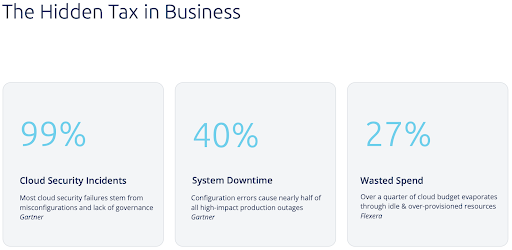
The data makes the problem hard to ignore. An overwhelming majority of cloud security failures, roughly 99% stem from misconfigurations and lack of governance, not zero-day exploits or sophisticated attacks. These are not exotic problems; they’re everyday issues like missing network policies, overly permissive IAM roles, or inconsistent security controls across environments.
Manual reviews and after-the-fact scanners might catch some of these issues, but they do so late, inconsistently, and at significant human cost.
Reliability
Reliability suffers in the same way. Around 40% of configuration errors are responsible for nearly half of high-impact production outages, meaning downtime is often self-inflicted. A single misconfigured resource limit, an unsafe deployment pattern, or an unvalidated infrastructure change can cascade into incidents that take hours to diagnose and resolve. Platform engineers are then pulled into reactive mode, firefighting instead of building better systems, while developers wait and business impact grows.
Cost
Cost is the third leg of this hidden tax. Roughly 27% of cloud spend is wasted, evaporating through idle, underutilized, or over-provisioned resources. This waste isn’t usually malicious or negligent; it’s structural. Humans are bad at continuously tuning thousands of resources across clusters and cloud accounts. Without automation, cost governance becomes a monthly report instead of a continuous control, and optimization efforts never quite catch up to reality.
Why Manual Platform Engineering Cannot Scale
At the root of all three problems, security, reliability, and cost is the same issue: manual, human-in-the-loop platform engineering does not scale. Infrastructure now changes at machine speed, driven by CI/CD pipelines, Kubernetes controllers, and increasingly AI-generated code and configurations. Asking humans to review, reason about, and remediate every change introduces delay, inconsistency, and burnout. The tax isn’t just time, it’s risk, outages, and wasted budget.
How AI-Native Platform Engineering Eliminates the Hidden Tax
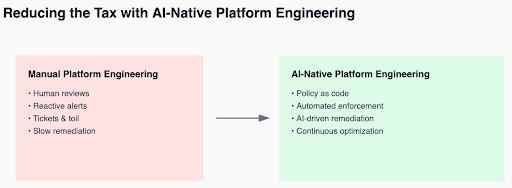
This is where automation and AI-native platform engineering change the equation. Policy-as-code allows platform teams to encode governance once and enforce it everywhere, across pipelines, clusters, and cloud resources, without relying on tribal knowledge or manual reviews. Automation catches misconfigurations before they reach production, not after an alert fires. AI agents can go further: interpreting violations, proposing or applying fixes, and continuously optimizing infrastructure based on real-time context rather than static rules.
The payoff is not fewer tools, but less hidden tax. Security issues are prevented instead of ticketed. Reliability improves because unsafe configurations never ship. Costs stay under control because optimization is continuous, not quarterly. Platform engineers regain time to focus on architecture, enablement, and paved roads, while automation and AI handle the repetitive, error-prone work at scale.
The Future of Platform Engineering
In an era where infrastructure change accelerates continuously, reducing this hidden tax may be the most critical outcome platform engineering teams can deliver. The question is no longer whether to automate platform engineering workflows, but how quickly organizations can implement AI-native approaches before the tax becomes unsustainable.

