Platform engineers face an impossible challenge: mastering dozens of specialized systems without a team of dedicated experts.
Modern platform teams must manage:
- Kubernetes orchestration and configuration
- Database performance optimization (MongoDB, PostgreSQL, etc.)
- Cloud infrastructure across AWS, Azure, and GCP
- Security policy enforcement with tools like Kyverno and OPA
- Observability stacks and incident response
This constant demand for highly specialized knowledge creates bottlenecks, burnout, and reactive firefighting.
The question isn’t whether specialization is necessary—it’s how to scale it without hiring a specialist for every system.
That’s where Anthropic SKILLs come in.
AI SKILLs—a breakthrough from Anthropic—offer a solution by codifying deep technical expertise into reusable, AI-powered tools that any team member can leverage.
What Are AI SKILLs?
An AI SKILL gives large language models (LLMs) reliable, specialized capabilities beyond their general training. Think of it as:
- A custom tool with clear instructions for specific technical domains
- A way to transform general-purpose AI into domain specialists
- Version-controlled expertise that teams can share and improve
How Anthropic SKILLs Differ from Standard LLM Prompting
Unlike basic prompt engineering, SKILLs provide:
- Structured, repeatable workflows for complex tasks
- Integration with real systems and APIs
- Automated execution of multi-step troubleshooting processes
- Organizational knowledge that persists across team changes
At Nirmata, we recognized this potential, and immediately implemented our own support for it in our Nirmata AI platform engineering assistant. This makes our solution independent of Anthorpic. Our assistant came pre-loaded with native SKILLs focused on our domain, such as Policy conversion (OPA to Kyverno, between Kyverno versions), Kyverno policy generation and Chainsaw tests. But the real game-changer is the ability for the agent to discover and learn new SKILLs.
Real World Test: A Production MongoDB Memory Incident
The opportunity to test this capability came quickly. We started getting alerts about high memory usage in our production MongoDB cluster.
The next step had to be a deep memory usage analysis. I knew a fix would require a significant amount of time researching database internals, even with help from a standard LLM.
Then a lightbulb moment – “why not translate this effort into a reusable Anthropic SKILL?” I should codify the solution so that the rest of the team never has to repeat the research.
The Process – From Troubleshooting to Reusable SKILL
- The Knowledge Base – Use an LLM to generate a very detailed, structured MongoDB memory troubleshooting guide.
- SKILL Generation – With the troubleshooting guide, then leverage Claude Code to write the required SKILL.md file and generate the supporting Python scripts.
- Deployment & Testing – Copy the generated code into the discovery directory used by the Nirmata assistant. It took about three iterations to refine the logic and ensure it performed.
- Execution & Results – Execute the new MongoDB Memory Analyzer SKILL on the production cluster. The SKILL provides immediate insight pointing directly to a sub-optimal WiredTiger cache configuration and specific indexes that need attention.
The recommended solution will allow us to safely save about 20 GB of memory. This enables us to switch to smaller AWS EC2 instances, representing a savings of around $1,400$/month.
The Unexpected Policy Guardrail
This is where the story shifts from fixing a problem to preventing future ones.
Because this specialized SKILL was running within the Nirmata AI assistant, something unexpected happened. After applying the fix and confirming the memory usage dropped, the agent asked to proactively install policies to check MongoDB configuration best practices, in order to avoid the issue from recurring.
We were so focused on solving the immediate fire that we hadn’t thought about the necessary guardrails. But the agent did! Empowered by SKILLs and Policy-as-Code.
Here is the key section of the Kyverno ClusterPolicy the agent generated:
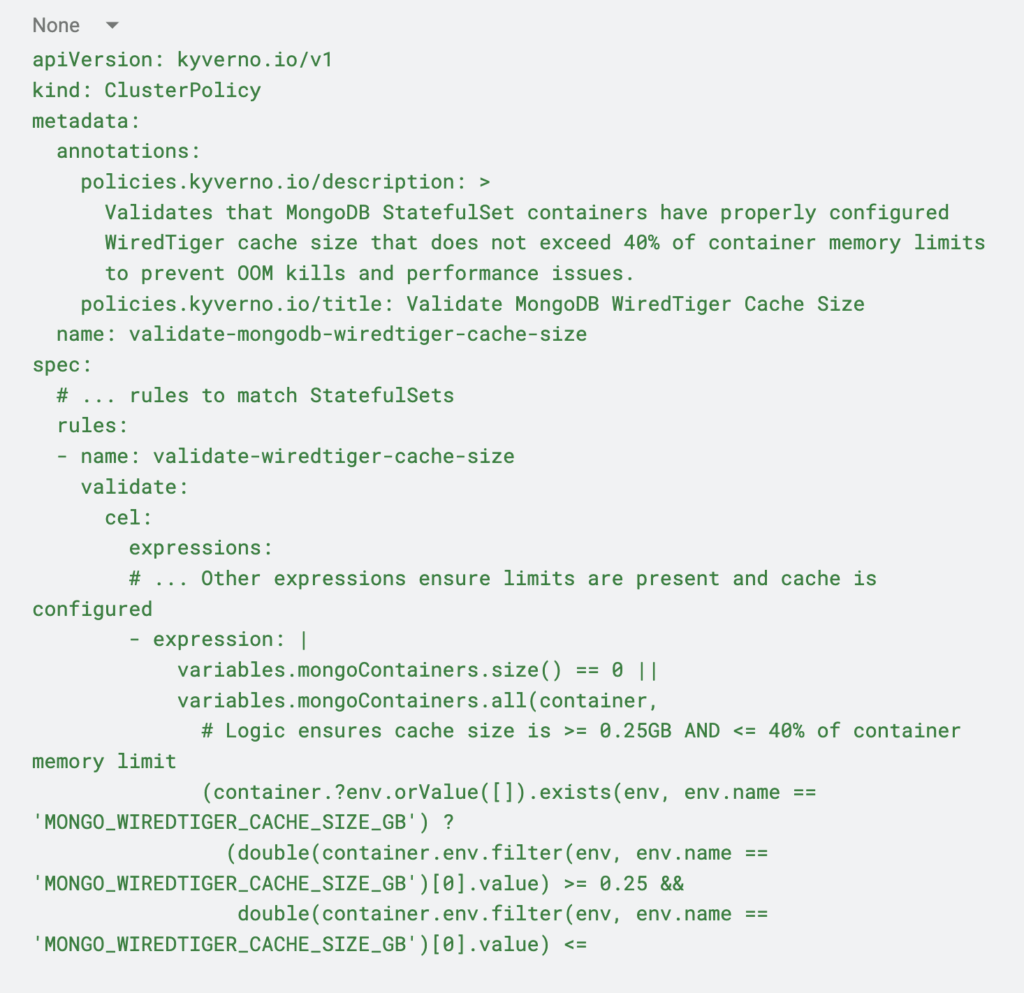
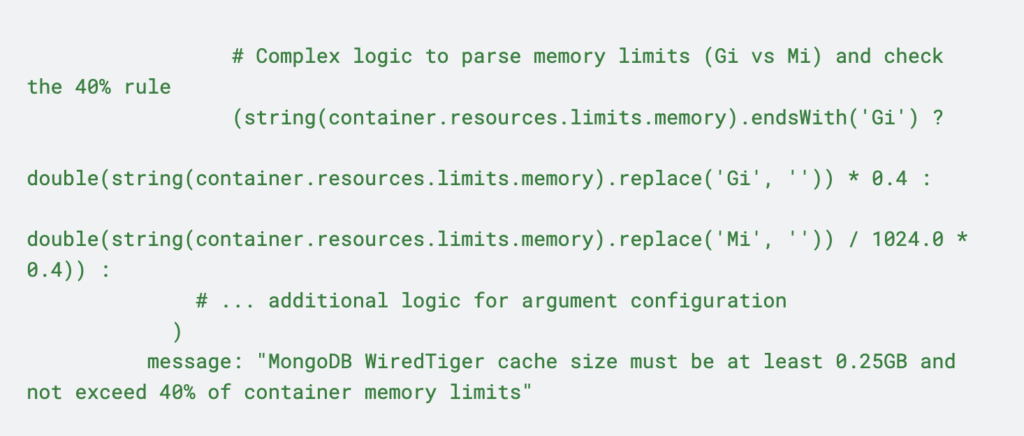
The Kyverno Policy uses complex CEL logic to automatically enforce the memory best practice discovered by the SKILL. This is the ultimate feedback loop: Reactive SKILL → Proactive Policy.
Why AI SKILLs Are a Breakthrough for Platform Engineering
The Anthropic SKILL technology is more than just a new feature, it’s potentially the missing link that platform engineering has needed for years.
1. The Specialization Multiplier
SKILLs turn one engineer’s deep expertise into an organizational asset that scales instantly.
2. Capturing Organizational Wisdom
Previously, critical knowledge lived in:
- Slack threads
- Incident retros
- Senior engineers’ heads
SKILLs provide a clean, version-controlled way to preserve and reuse it.
3. Bridging the Heterogeneity Gap
Kubernetes, MongoDB, cloud providers, policy engines—SKILLs act as the abstraction layer that lets generalists operate like specialists.
This could be the future of platform engineering – a system that empowers generalists with expert knowledge, leading to tangible cost savings, better stability, and a truly proactive posture.
From Firefighting to Future-Proofing
The MongoDB incident revealed something fundamental about the future of platform engineering. We didn’t just solve a memory problem—we created a reusable solution, then built guardrails to prevent recurrence. All in a fraction of the time traditional troubleshooting would require.
This is the promise of AI SKILLs: transforming reactive expertise into proactive organizational capabilities. Every problem solved becomes institutional knowledge. Every specialist’s insight scales across the entire team.
For platform engineers drowning in complexity, SKILLs offer a way forward that doesn’t require hiring specialists for every technology in your stack. Instead, you capture expertise once and deploy it infinitely.
Ready to see how AI SKILLs can transform your platform engineering workflow? Try Nirmata’s AI assistant and start building your own library of specialized capabilities today.