


Kyverno is a Kubernetes-native policy engine that allows DevOps teams to define, validate, mutate, and generate Kubernetes resources using simple YAML-based policies. Unlike other policy tools, Kyverno works without custom languages, making policy enforcement easier to adopt and manage at scale.
In short: Kyverno lets you enforce Kubernetes best practices automatically, using the same YAML you already use for manifests.
What Is Kyverno?
Kyverno is an open-source policy management tool designed specifically for Kubernetes. It enables teams to apply Policy as Code directly to Kubernetes clusters by evaluating resources against declarative rules written in YAML.
Kyverno runs as a Kubernetes admission controller and enforces policies when resources are created, updated, or deleted.
How Kyverno Works in Kubernetes
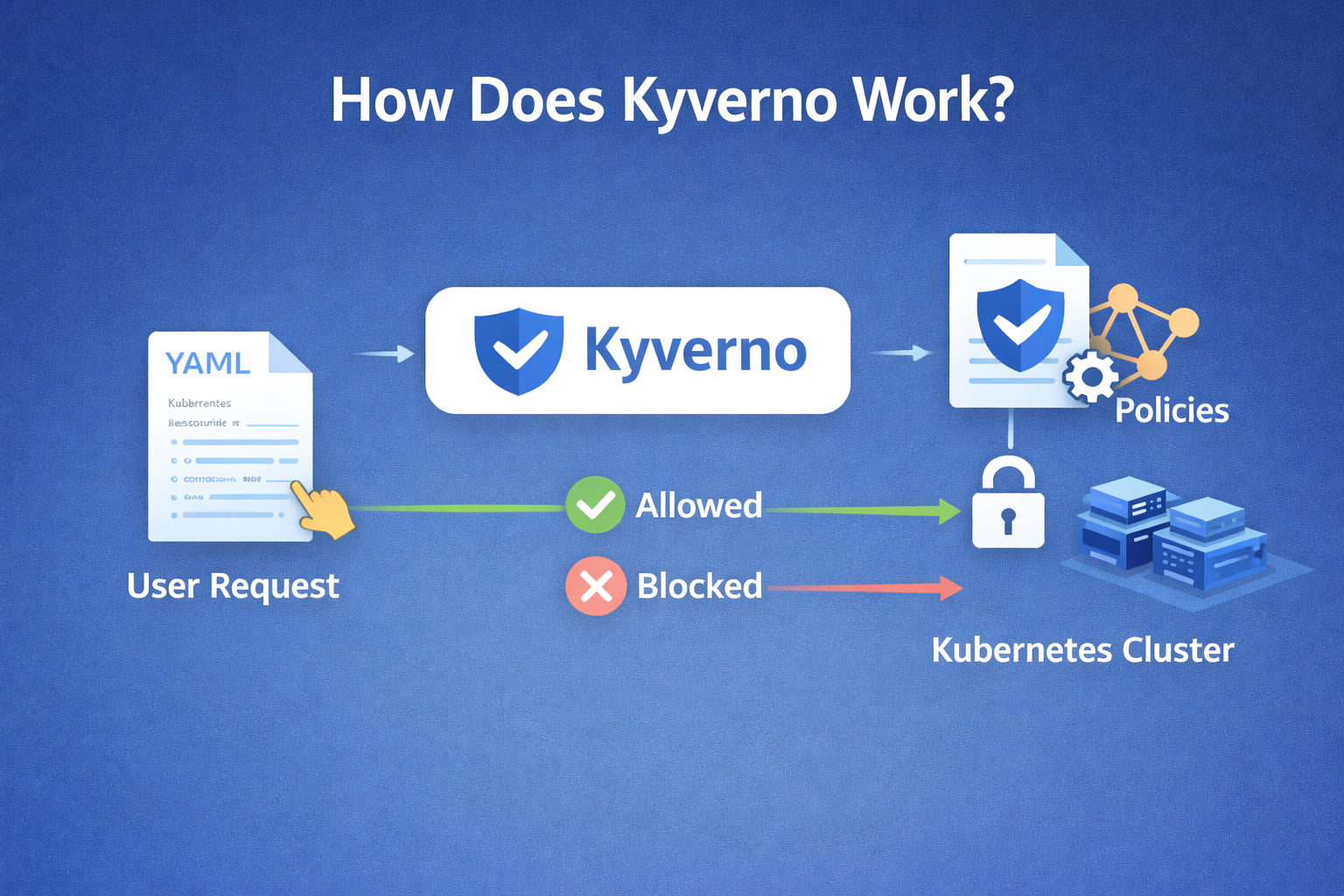
Kyverno operates by intercepting Kubernetes API requests and evaluating them against predefined policies before the request is allowed to proceed.
The basic flow looks like this:
- A Kubernetes resource is submitted (such as a Pod or Deployment)
- Kyverno evaluates the resource against applicable policies
- Kyverno allows, modifies, or blocks the request
- The resource is admitted into the cluster or rejected
This process happens automatically and in real time, without manual intervention.
Kyverno’s Core Policy Types Explained
Kyverno policies fall into four main categories that cover most Kubernetes governance needs.
Validation Policies (Validate)
Validation policies ensure Kubernetes resources meet specific requirements before deployment.
Common use cases include requiring CPU and memory limits, blocking privileged containers, enforcing approved container registries, and requiring labels like environment or owner.
The result is that misconfigured or insecure workloads never reach production.
Mutation Policies (Mutate)
Mutation policies automatically modify Kubernetes resources during admission.
They are commonly used to add labels or annotations, inject security contexts, apply default resource limits, or standardize configurations across teams.
This means developers don’t need to remember every rule—Kyverno applies them automatically.
Generation Policies (Generate)
Generation policies automatically create additional Kubernetes resources when certain conditions are met.
Examples include creating NetworkPolicies for new namespaces, generating ConfigMaps or Secrets, or enforcing default RBAC rules.
This ensures consistency and security without manual setup.
Cleanup Policies (Cleanup)
Cleanup policies remove unused or non-compliant resources over time.
They can delete expired resources, clean up old test namespaces, or remove non-compliant workloads, reducing clutter and operational risk.
Why DevOps Teams Prefer Kyverno
Kyverno aligns closely with existing Kubernetes workflows, which makes it popular with DevOps and platform teams.
Key advantages include:
- YAML-based policies with no custom language required
- Kubernetes-native architecture
- Easy-to-read and auditable policies
- Strong compatibility with GitOps workflows
- Effective support for multi-cluster environments
Kyverno vs Other Kubernetes Policy Tools
When compared to OPA Gatekeeper, Kyverno is often preferred for its simplicity.
Kyverno uses YAML for policies, supports built-in mutation, has a lower learning curve, and is easier for DevOps teams to adopt. OPA Gatekeeper offers greater flexibility for complex logic but requires learning Rego and typically involves more setup.
The practical takeaway is that Kyverno works best for teams that want fast adoption and clear policies, while OPA is better suited for advanced policy logic.
How Kyverno Fits into CI/CD Pipelines
Kyverno can enforce policies before code ever reaches a Kubernetes cluster.
Teams commonly use Kyverno to validate manifests during pull requests, fail builds when policies are violated, and test policy changes alongside application code. This enables shift-left security and reduces rework later in the deployment process.
Real-World Example: Kyverno in Action
Imagine a team deploying a new application without setting resource limits.
Without Kyverno, the pod is deployed and may consume excessive cluster resources. With Kyverno in place, a validation policy can block the deployment, or a mutation policy can automatically add default resource limits.
In both cases, cluster stability is preserved without slowing developers down.
Best Practices for Using Kyverno
DevOps teams get the most value from Kyverno by starting with policies in audit mode, keeping policies small and focused, version-controlling them with Git, documenting policy intent clearly, testing policies in CI pipelines, and reviewing policies regularly as clusters evolve.
Simplify Kyverno Policy Management at Scale with Nirmata
Kyverno is powerful, but managing policies across clusters, teams, and environments can quickly become complex.
Nirmata helps DevOps and platform teams:
- Centrally manage Kyverno policies across multiple clusters
- Enforce security and compliance consistently at scale
- Integrate policy enforcement into CI/CD and GitOps workflows
- Gain visibility into policy compliance across environments
Whether you’re just getting started with Kyverno or scaling Kubernetes governance enterprise-wide, Nirmata provides the control and automation teams need—without slowing developers down. Request a demo today.


