


The Kubernetes security market, valued at $1.195 billion in 2022, is projected to reach $10.7 billion by 2031 (27.6% CAGR) due to the need for robust authorization. As organizations adopt zero-trust security models, they’re moving from perimeter-based defenses toward granular, identity-aware access control inside the cluster.
While API gateways manage external access (north-south traffic), it’s crucial to enforce authentication and authorization for internal (east-west) traffic. Kyverno provides a unified, policy-as-code framework for both Kubernetes resource admission and service-to-service authorization, meeting security and compliance needs.
What is Kyverno Authz-Server
The Kyverno Authz-Server is a gRPC server that implements the Envoy External Authorization API. It enables Kyverno policies to be applied to incoming and outgoing traffic within a service mesh—enforcing context-aware access control without modifying microservices.
You can use this version of Kyverno to enforce fine-grained, context-aware access control policies with Envoy without modifying your microservice. In short, Kyverno Authz-Server extends policy-as-code from admission control to runtime authorization across both north-south and east-west traffic.
Kubernetes Authorization Challenges (and How Kyverno Solves Them)
1. Performance and Resource Efficiency at Scale (The Sidecar Problem)
- The Challenge: Traditional authorization relies on sidecar-related containers (like OPA/Envoy bundles) that run in every application pod. This architecture consumes a substantial amount of CPU and memory resources per-pod, particularly in large clusters, leading directly to higher cloud costs and increased scheduling pressure.
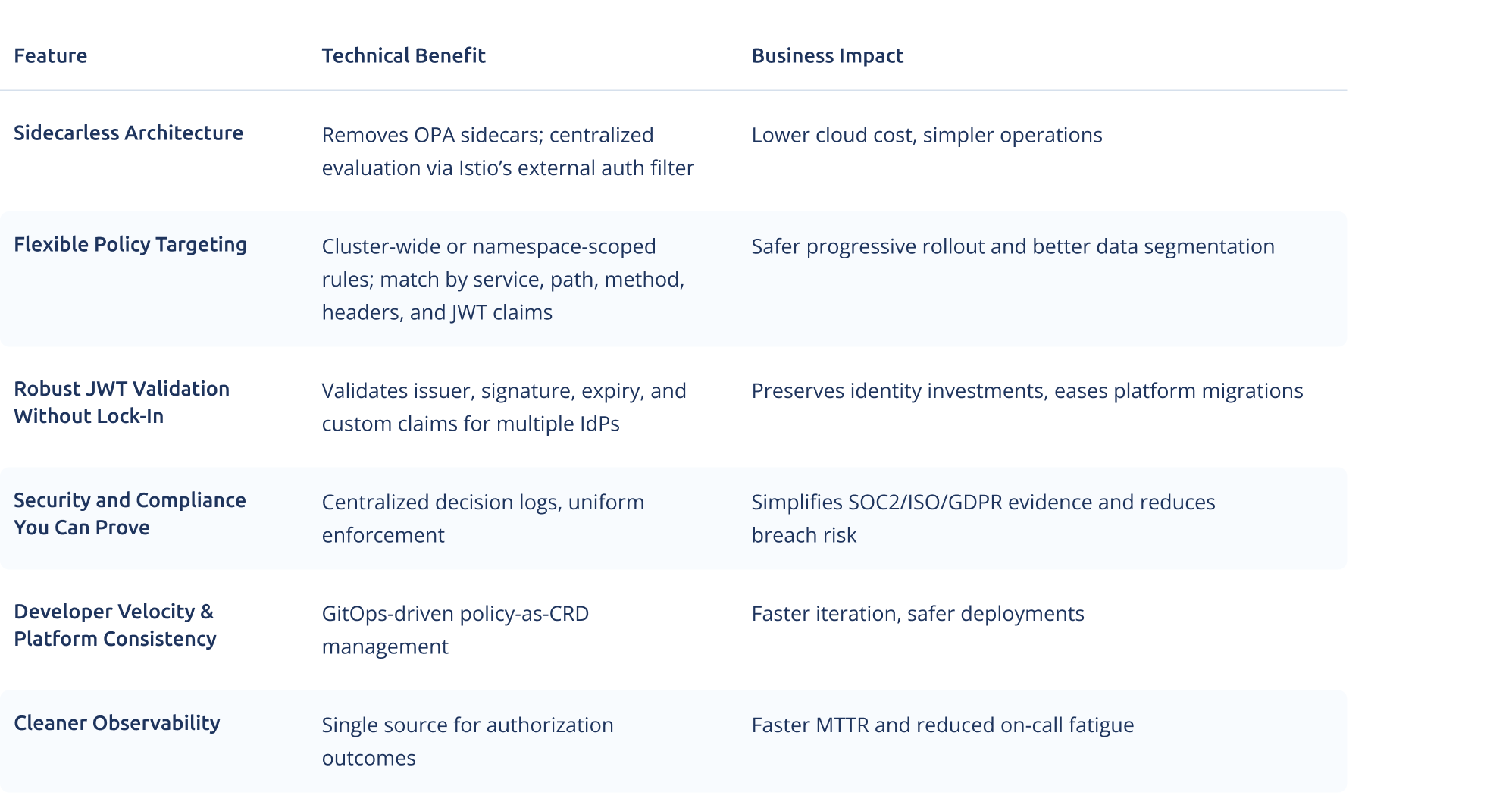
- The Kyverno Solution: Sidecarless Architecture The Kyverno Authz-Server centralizes policy evaluation using the native Envoy External Authorization API. This eliminates the need for a separate policy sidecar in every workload, drastically reducing pod count, lowering compute and memory overhead, and improving authorization latency for a leaner, faster service mesh.
2. Centralized Policy Rollout and Rollback
- The Challenge: Distributing authorization logic and policy bundles across hundreds or thousands of individual sidecars presents a significant hurdle for policy rollout, testing, and rollback. This often results in complex, high-risk implementations across large service meshes.
- The Kyverno Solution: Single Control Plane By running as a central service, Kyverno provides a single, unified control plane for authorization policy. This centralized approach enables faster, GitOps-driven rollout, safer rollback, and consistent, auditable policy enforcement across all services.
3. Robust JWT Validation Without Vendor Lock-In
- The Challenge: Implementing full-featured JWT validation (checking issuer, signature, expiry, and custom claims) often forces reliance on specific, proprietary libraries or a single Identity Provider (IdP), leading to vendor lock-in and a brittle authorization layer.
- The Kyverno Solution: Flexible, Claim-Based JWT Validation Kyverno Authz-Server performs issuer, signature, expiry, and claims validation directly. It offers configurable support for any OIDC-compliant IdP (e.g., AWS Cognito, Azure AD, Keycloak, Okta), allowing you to preserve existing identity investments while gaining stronger, vendor-neutral enforcement.
4. Inconsistent Policy for Mesh Traffic
- The Challenge: Many solutions struggle to enforce the same fine-grained policies for both perimeter access (north-south traffic) and internal service-to-service communication (east-west traffic) without requiring application code changes or creating architectural variance.
- The Kyverno Solution: Mesh-Native Integration Kyverno policies are enforced consistently at both the ingress gateway and between internal services using Istio/Envoy’s native hooks. This ensures full zero-trust alignment across the entire service mesh, applying uniform controls regardless of the traffic source without requiring application code modifications.
5. Security and Compliance Reporting Complexity
- The Challenge: Fragmented authorization decisions across distributed sidecars make generating clear, unified audit trails for compliance mandates (like SOC2, ISO, or GDPR) time-consuming and unreliable, increasing organizational risk.
- The Kyverno Solution: Provable Security and Compliance All centralized authorization decision logs and metrics are collected in one place. These uniform controls simplify evidence collection and compliance reporting, making the authorization process transparent, faster, and more reliable for internal and external auditors.
6. Fragmented Observability and Troubleshooting
- The Challenge: Debugging distributed policy failures requires logging into individual pods, correlating logs across numerous sidecars, and using specialized tooling. This significantly increases operational drag and slows down incident response.
- The Kyverno Solution: Cleaner Observability and Faster MTTR The centralized Kyverno Authz-Server provides a single, unified place to inspect authorization outcomes. Unified decision logs and metrics reduce noise, leading to faster incident resolution and a significantly shorter Mean Time To Repair (MTTR), reducing on-call fatigue.
Key Differentiators
Here are some key differentiators of the Kyverno Authz-Server:
Where Kyverno Authz-Server Delivers Immediate Value
- Cost-sensitive environments: Consolidating authorization eliminates the need for per-pod sidecars and their associated cloud costs.
- Regulated workloads: Centralized, auditable policies accelerate compliance and reduce variance across teams.
- High-change organizations: Rapid policy updates and GitOps workflows enable safe, frequent iteration.
- Large mesh deployments: Consistent enforcement and simpler ops become force multipliers at scale.
Implementation Strategy
Follow this step-by-step approach to adopt Kyverno Authz-Server efficiently:
- Start with one namespace or service group to validate performance and policy coverage.
- Integrate with your existing IdP (e.g., Cognito) for JWT issuance; configure issuer/certs in policy.
- Manage policies via GitOps; measure resource usage, latency impact, and change velocity to optimize performance.
- Expand incrementally, retiring sidecars as confidence grows.
Conclusion
Centralized authorization via a Kyverno Auth Server turns a complex, costly, and fragmented control plane into a fast, auditable, and scalable service. By centralizing Kubernetes API authorization, teams gain lower cloud spend, stronger zero-trust enforcement, simplified compliance, and higher developer velocity—without rewriting applications.
Ready to implement this in your environment? Get started with the deep dive tech blog. Integrate with your existing IdP (AWS Cognito, Azure AD, Okta), manage policies via GitOps, and measure the resource savings. As confidence grows, expand incrementally, retiring sidecars and enjoying the operational simplicity of centralized authorization.
Next steps:
Explore the code: The complete example is available at this link
Read more about Kyverno: kyverno.io/docs
Learn Istio security: istio.io/docs/concepts/security
Platform engineering best practices: Explore how policy-as-code accelerates DevSecOps workflows at scale
The future of Kubernetes authorization is centralized, declarative, and mesh-native. Start building it today.


