


AI is about to create more infrastructure change than humans ever did.
Not just application code—Kubernetes manifests, Helm values, Terraform, pipeline definitions, and “quick fixes” generated by copilots and agents. That velocity is exciting, but it exposes a hard truth for platform leaders:
If your standards live in docs, AI will ignore them.
If your standards live in policy-as-code + workflows, AI will follow them.
This is why the next phase of platform engineering isn’t “adopting AI.” It’s operationalizing AI so changes are safe, auditable, and consistent across every team and every cluster.
That’s what “paved roads” look like in an AI world:
- Developers move fast with AI assistance.
- AI can propose changes freely.
- The platform enforces what’s allowed—automatically and consistently.
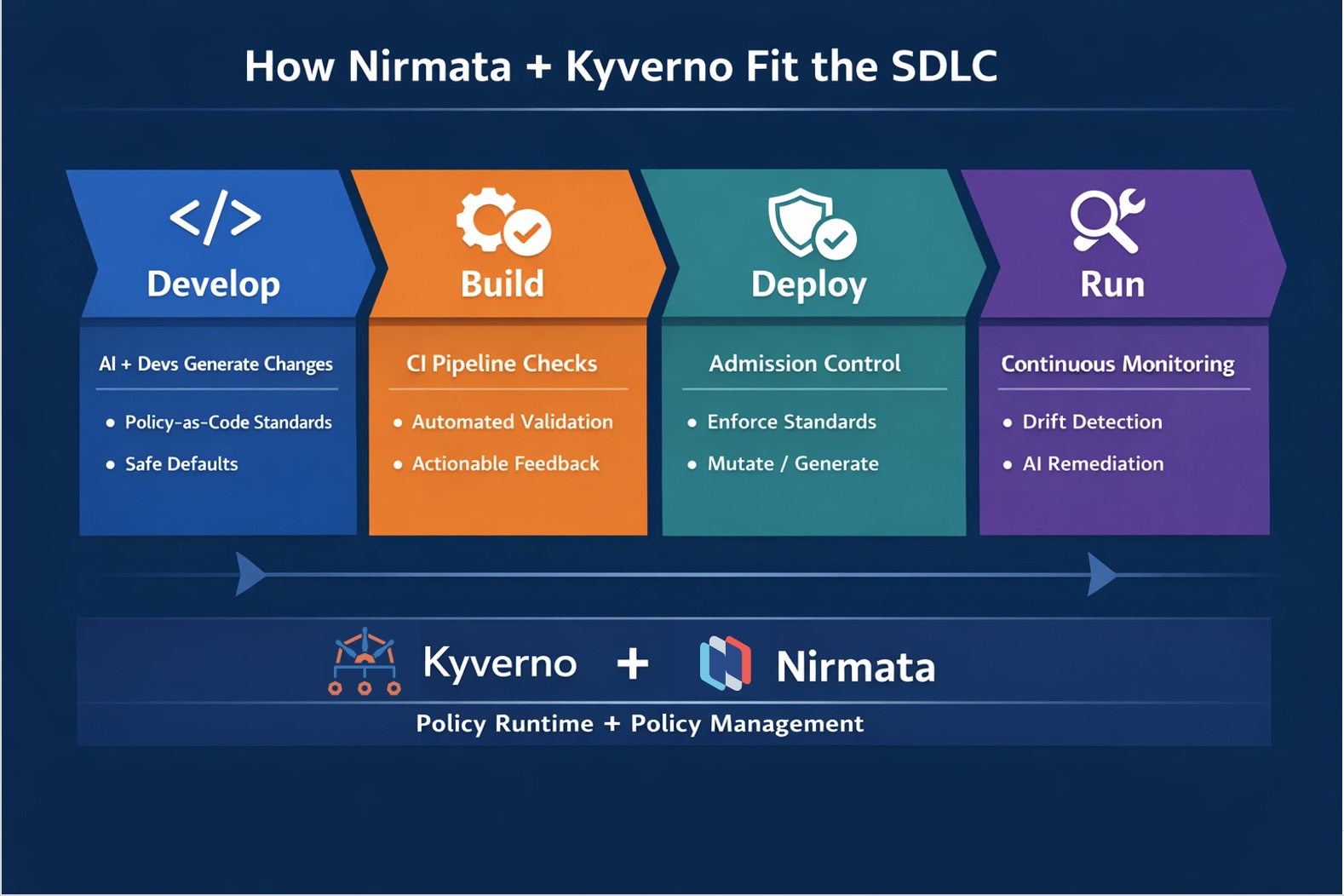
Kyverno + Nirmata provide the guardrail system to do this across the full software lifecycle: Develop → Build → Deploy → Run.
Why AI changes the platform equation
AI increases both the volume and variance of changes:
- More changes: A developer can generate multiple variations of manifests in minutes.
- More inconsistency: AI outputs reflect the internet, not your platform standards.
- More risk: Small config mistakes become fleet-wide when replicated by AI.
- More toil: Manual review and TicketOps don’t scale with AI throughput.
In other words: AI accelerates delivery—but also amplifies misconfigurations. So the control plane for the AI era must answer:
- What is allowed?
- Where do we enforce it?
- How do we roll it out safely across clusters?
- How do we handle exceptions without creating permanent risk?
That’s exactly what the Nirmata Platform is built for.
The mental model: AI proposes, the platform decides
- Kyverno is the policy engine for Kubernetes, CI/CD pipelines and cloud. It lets you express platform intent as policies and enforce it consistently through validation, mutation, and generation.
- Nirmata operationalizes policy at scale: policy lifecycle management, rollout, visibility, exception workflows, and AI-assisted experiences for creating, testing, and troubleshooting guardrails.
AI can propose changes.
The platform decides what gets shipped and ensures that it is secure.
How Nirmata + Kyverno fits each SDLC phase
| SDLC phase | What teams are trying to achieve | Kyverno role (policy engine) | Nirmata role (control plane + AI + workflows) | Outcome for devs |
| Develop | Make the safe path the easiest path | Encode platform standards as policies (security, reliability, cost, conventions) | AI-assisted policy creation + centralized policy lifecycle (curation, versioning, testing) so platform teams ship guardrails faster. IDE extensions for scanning manifests | Early feedback, faster PRs, fewer back-and-forth tickets |
| Build | Catch problems early, when fixes are cheapest | Run the same policy intent in CI on manifests (and related artifacts) | Standardize policy checks across repos/pipelines; consistent reporting + exception workflow integration | Issues caught before deploy; fewer late surprises |
| Deploy | Enforce standards at the point of change | Admission control to validate/mutate/generate resources to meet standards by default | Safe rollout across clusters; manage exceptions and approvals as an operational workflow | “Works on first deploy,” fewer blocked releases |
| Run | Keep production in a known-good state | Background evaluation + drift/violation detection | Fleet visibility + workflow automation; AI-assisted troubleshooting/remediation patterns to reduce toil | Lower MTTR; fewer recurring hygiene findings |
Develop: Make AI output platform-compliant by default
Platform teams already know what “good” looks like:
- approved base workload patterns
- required labels/ownership metadata
- restricted container privileges
- resource requests/limits and probes
- network exposure rules
- cost guardrails and operational standards
The problem is that these rules are often scattered across docs, tribal knowledge, and one-off reviews.
In an AI-driven workflow, that breaks immediately.
A better approach is to turn standards into executable intent:
- Guardrails become policies, not guidelines.
- Defaults become automation, not reminders.
The “golden path” becomes the easiest path.
This is where Kyverno shines: it encodes platform standards in a Kubernetes-native way, so both humans and AI-generated changes are evaluated against the same contract. Nirmata helps platform teams scale that contract:
- curate reusable policy sets
- manage versions and rollout safely
- iterate quickly as standards evolve
The AI twist: policy-as-code becomes the interface between AI and your platform.
Instead of hoping AI “knows your standards,” you enforce them.
Build: Replace manual review with automated, explainable feedback
With AI, teams can generate PRs faster than humans can review them. That means the pipeline must become the primary feedback system. What “good” looks like in the Build phase:
- the same guardrails you enforce at deploy time
- enforced consistently across repos and teams
- feedback that is actionable, not cryptic
- exceptions that are managed (and time-bounded), not ad hoc
Kyverno gives you the policy logic.
Nirmata helps operationalize it across teams: standard checks, reporting, and exception workflows that don’t devolve into Slack messages and spreadsheets.
The AI twist: pipeline feedback should feel like an assistant:
- what failed
- why it matters
- what the compliant fix looks like
This is how you keep AI-driven velocity without scaling risk.
Deploy: Admission control is the AI safety net
Deploy is where platform intent becomes real. In an AI world, you cannot depend on:
- perfect prompts
- perfect generated YAML
- consistent human review
You need enforceable guardrails at the point of change. Kyverno provides admission control that can:
- validate unsafe changes (block them)
- mutate changes to apply safe defaults automatically
- generate supporting resources when a standard implies it
Nirmata adds what platform leaders actually need at scale:
- safe rollout of policies across clusters and environments
- visibility into impact, adoption and compliance
- operational exception workflows (approval, expiry, ownership)
The AI twist: you don’t need perfect AI. You need a platform that can safely accept AI-generated changes.
Run: Close the loop with AI-assisted operations (without chaos)
Most platform pain isn’t caused by one catastrophic mistake. It’s caused by repetition:
- misconfigs that keep coming back
- drift that accumulates quietly
- hygiene findings that never truly go away
This is where platforms either become a force multiplier—or drown in TicketOps.
Kyverno helps continuously evaluate resources and surface violations and drift.
Nirmata turns that into action across the fleet: visibility, ownership workflows, policy recommendations, automated remediation, and governed exception handling.
The AI twist: move from “dashboards” to “closed-loop operations.”
AI can help:
- summarize likely root cause
- identify the owning team/service
- propose a safe remediation aligned to policy
- reduce time-to-resolution and prevent repeat findings
The goal isn’t “AI for everything.” It’s AI that reduces toil while staying constrained by policy.
Exceptions are the hidden risk multiplier (and why AI makes it worse)
Every platform has exceptions. The difference is whether exceptions are:
- visible
- owned
- time-bounded
- auditable
In AI-driven environments, unmanaged exceptions become the perfect mechanism for accidental risk propagation:
A single bypass becomes a copied pattern, then a default, then a fleet-wide issue.
A modern platform needs exception operations built-in:
- approval workflow
- expiry
- scope controls
- reporting and review
- auditability (who, when, why)
This is a key reason to treat guardrails as an operational system—not a pile of YAML rules.
Getting started: a practical rollout plan
If you’re building an AI-ready internal platform, start with guardrails that remove the most friction and risk:
- Pick 10 high-impact standards
Focus on what causes the most production risk and the most tickets. - Prefer safe-by-default automation
Use mutation/generation where it reduces developer toil. - Enforce at deploy first
Admission control delivers immediate leverage. - Shift the same rules earlier into CI
Faster feedback, fewer surprises. - Operationalize exceptions from day one
Time-bounded, owned, and visible. - Automate remediations
Eliminates cross-team friction.
Conclusion: AI-speed delivery needs policy-native guardrails
The winning platform strategy in the AI era isn’t simply “use AI to move faster.”
It’s:
move faster while making changes safe, auditable, and consistent by default.
That requires more than guidelines. It requires systems.
Kyverno provides the policy runtime.
Nirmata provides policy operations at scale.
Together, they help platform teams build paved roads—not speed bumps— for AI-driven delivery across Develop, Build, Deploy, and Run.
If you’re a platform leader planning for AI-driven infrastructure changes, we’d love to share a reference rollout: the first policy set, exception workflows, and a phased enforcement plan across CI, admission, and runtime. Reach us here.

Sorry, the comment form is closed at this time.