


Fixing what Kyverno finds is a different story.
The gap between “detected” and “fixed”
Here’s what actually happens after Kyverno flags a violation. Someone has to:
- Identify the affected resource
- Track down the Git repository that owns it
- Update the manifest by hand
- Open a pull request
- Get it reviewed
- Wait for GitOps to sync it back to the cluster
That’s a lot of manual steps for each violation. Now multiply it across dozens of clusters, and it stops being an occasional chore and starts being a permanent, repetitive tax on your platform team’s time, one that scales with your cluster count, not with your headcount.
This is the gap the Nirmata Remediator agent is designed to close.
What the Remediator actually does
The Remediator picks up exactly where Kyverno leaves off. It:
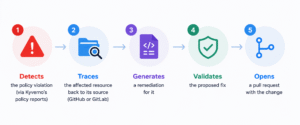
The important design decision here: the Remediator never touches your live cluster directly. Git stays the source of truth, and every change still goes through the same review and approval process your team already uses. It’s automation inside your existing GitOps workflow, not a bypass of it.
How it fits together
At a high level, the Remediator runs as a Kubernetes operator, sitting alongside Kyverno rather than replacing anything it does:
- Kyverno runs in the cluster and produces policy reports containing violations.
- The Remediator reads the violations relevant to its configured targets and filters.
- For each violation, it traces the resource back to its Git source and proposes a fix.
- That proposed change can come from an LLM or it can be fully deterministic, with no AI involved at all, depending on how you configure it.
- The agent commits the fix and opens a pull request. A person on your team reviews and merges it, exactly like any other change.
- ArgoCD or Flux CD picks up the merge and syncs it back to the cluster.
- Kyverno re-evaluates, the violation clears, and the loop closes.
End to end, the process is automated but at no point does it step outside your normal Git or GitOps process.
Under the hood: a Service Agent with three CRs and a controller
The Nirmata Remediator runs as a Service Agent i.e., it executes autonomously in Kubernetes with its own identity.
Remediator can be installed via Helm. Once running, the setup boils down to a controller and three custom resources:
Controller deployment of the engine. It runs continuously, watches your configuration, and executes remediations.
Remediator CR tells the engine three things:
- Where to look: for example, running in ArgoCD hub mode and targeting applications managed by ArgoCD
- When to run: a schedule (every six hours in the demo), plus event polling so it isn’t only waiting on the cron
- What to do: the action to take (create a PR), along with references to the LLM config and tool config that wire the generation and delivery together
LLM config : configures the AI provider (Nirmata AI, which is the default, in the demo) used to turn a detected violation into a concrete suggested change. You can also configure your own LLMs (BYOK).
Tool config : the Git integration. In the demo this was GitHub, via the Nirmata GitHub app, which lets the agent create a branch and open the pull request once it has a fix.
What a Remediator PR looks like
When a violation is found and a fix generated, the resulting pull request isn’t a bare diff. It includes:
- A description of every violation found and the fix for each
- An explanation of the runtime impact of applying the change
- A confidence score for the proposed fix
- The full set of suggested changes, ready for review
Your reviewer sees exactly what’s broken, exactly what’s being changed, and how confident the agent is before anything merges.
Watch it in action
We walked through the full flow architecture, configuration, and a live violation turning into a pull request in this video: https://youtu.be/dw_JbhS3aA0?si=uXqUxQtog8G1PKuB
Tell us how you’re doing this today
Policy violation cleanup looks different at every organization; some teams script parts of it, some rely on tickets and Slack reminders, some just let the backlog grow. We’d like to know how your team handles it, and what you’d want to see the Remediator do next.
Want to see how the Remediator Agent could work for your team? We’d be happy to show you. Reach us at hello@nirmata.com

