


Infrastructure has quietly crossed a threshold. What was once a steady, reviewable stream of changes has become a continuous flood driven by cloud APIs, Kubernetes controllers, CI/CD pipelines, and now AI-generated infrastructure. Platform engineers are no longer just managing infrastructure, they’re trying to govern an always-on system that evolves faster than any human approval process can keep up.
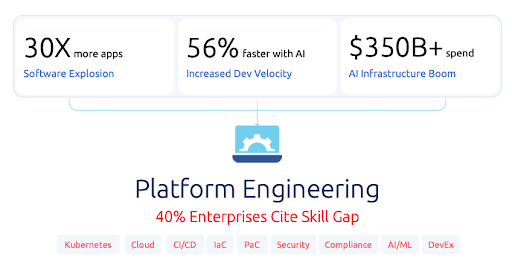
As AI accelerates application development and deployment, infrastructure change velocity has exploded, and traditional human-in-the-loop governance simply doesn’t scale.
The result is a widening gap between how fast infrastructure changes and how fast platform teams can reason about risk, cost, security, and compliance.
Why Traditional Infrastructure Governance Is Breaking Down
Every Terraform plan, Helm release, or Kubernetes deployment represents dozens, or hundreds, of implicit decisions. Multiply that across teams, regions, clusters, and clouds, and governance becomes a bottleneck. This isn’t a tooling problem; it’s a cognitive one.
Platform engineers are now expected to be experts in:
- Cloud security
- Reliability and SRE practices
- Cost optimization (FinOps)
- Compliance and regulatory controls
- Developer enablement
Unsurprisingly, many enterprises now cite a growing platform engineering skill gap as infrastructure complexity outpaces human capacity.
The AI Paradox in Platform Engineering
What makes this moment different is that your platform is already AI-native, but your platform engineering practices are not. Developers increasingly rely on AI copilots to generate code, manifests, and infrastructure definitions in seconds. But governance still relies on manual reviews, tribal knowledge, and reactive detection after changes hit production. CNAPPs, CSPMs, and scanners are excellent at telling you what went wrong, but they operate downstream, after risk has already been introduced. Platform teams are left firefighting instead of shaping what “right” looks like upfront.
Policy as Code: The Foundation for Scalable Cloud Governance
To keep up with infrastructure velocity, governance must move earlier and become automated by default. This is where policy-as-code becomes essential.
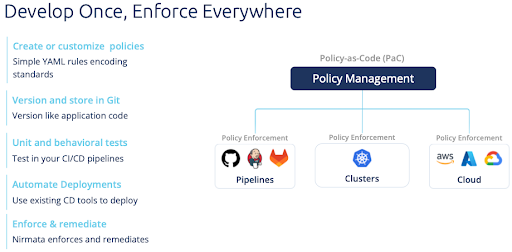
By encoding intent, security controls, operational best practices, cost guardrails – as declarative policy, platform engineers can move governance earlier in the lifecycle and enforce it consistently across pipelines, clusters, and cloud infrastructure.
Technologies like Kyverno have shown that policy doesn’t have to be abstract or inaccessible.
Policies can:
- Live alongside Kubernetes and IaC definitions
- Use familiar formats like YAML and CEL
- Integrate directly into developer workflows
By using one policy framework enforced everywhere, organizations dramatically reduce the cognitive load on platform teams while increasing consistency and reliability.
Why Policy Alone Isn’t Enough
As infrastructure scale increases, platform engineers also need automation that understands context, what changed, where, why it matters, and how to fix it. This is where AI-native platform engineering starts to emerge.
Instead of engineers manually interpreting violations, AI agents can:
- Detect misconfigurations before deployment
- Explain policy violations in plain language
- Suggest or apply remediations
- Continuously prevent drift from defined guardrails
Governance stops being a gate that slows teams down and becomes an automated system that continuously keeps infrastructure within guardrails.
The Future: AI Platform Engineering
Platform engineering is evolving from a reactive, human-driven function into an autonomous, AI-assisted discipline. The goal isn’t to replace platform engineers, but to amplify them, automating the most complex and repetitive parts of the job, while preserving human judgment for design, intent, and strategy.
By building a strong governance foundation first and layering AI on top, platform teams can finally keep pace with infrastructure change instead of being crushed by it.
Ready to get started? Request a demo.

