

Executive Summary
As Kubernetes adoption accelerates, organizations face increasing challenges in securing, governing, and managing complex cloud-native environments. Traditional approaches to policy enforcement often fall short in addressing the dynamic and scalable nature of Kubernetes clusters, leaving gaps in security, compliance, and operational consistency. To meet these demands, Kubernetes-native solutions that integrate seamlessly with existing workflows and tools are essential.
Kyverno, a Cloud Native Computing Foundation (CNCF) project, is a policy engine purpose-built for Kubernetes. Designed to simplify policy management, Kyverno allows teams to define, enforce, and automate policies using familiar YAML configurations—eliminating the need to learn complex programming languages like Rego. Its native integration with Kubernetes enables organizations to enforce security best practices, automate resource management, and maintain governance across development, testing, and production environments.
This whitepaper presents a comprehensive guide to implementing Kyverno in production environments, focusing on best practices for scalable and secure policy management. It covers critical aspects such as installation, policy design, performance optimization, observability, and security hardening. Real-world use
By following the strategies outlined in this whitepaper, platform engineering and DevOps teams can effectively leverage Kyverno to:
- Enhance Kubernetes Security: Enforce Pod Security Standards, restrict container registries, and prevent misconfigurations.
- Automate Governance and Operations: Streamline namespace provisioning, resource generation, and policy-driven automation.
- Simplify Policy Management: Manage policies declaratively using native Kubernetes resources and YAML syntax.
- Ensure Continuous Compliance: Gain real-time visibility into policy compliance through reporting and monitoring tools.
- Scale Securely: Optimize Kyverno deployment for high availability, performance, and scalability across clusters.
Kyverno empowers organizations to operationalize security and governance at scale, enabling secure, compliant, and automated Kubernetes operations. This whitepaper serves as a practical resource for deploying Kyverno in production, helping teams build robust, policy-driven cloud-native infrastructure.
Chapter 1
Introduction to Kyverno
1.1 What is Kyverno?
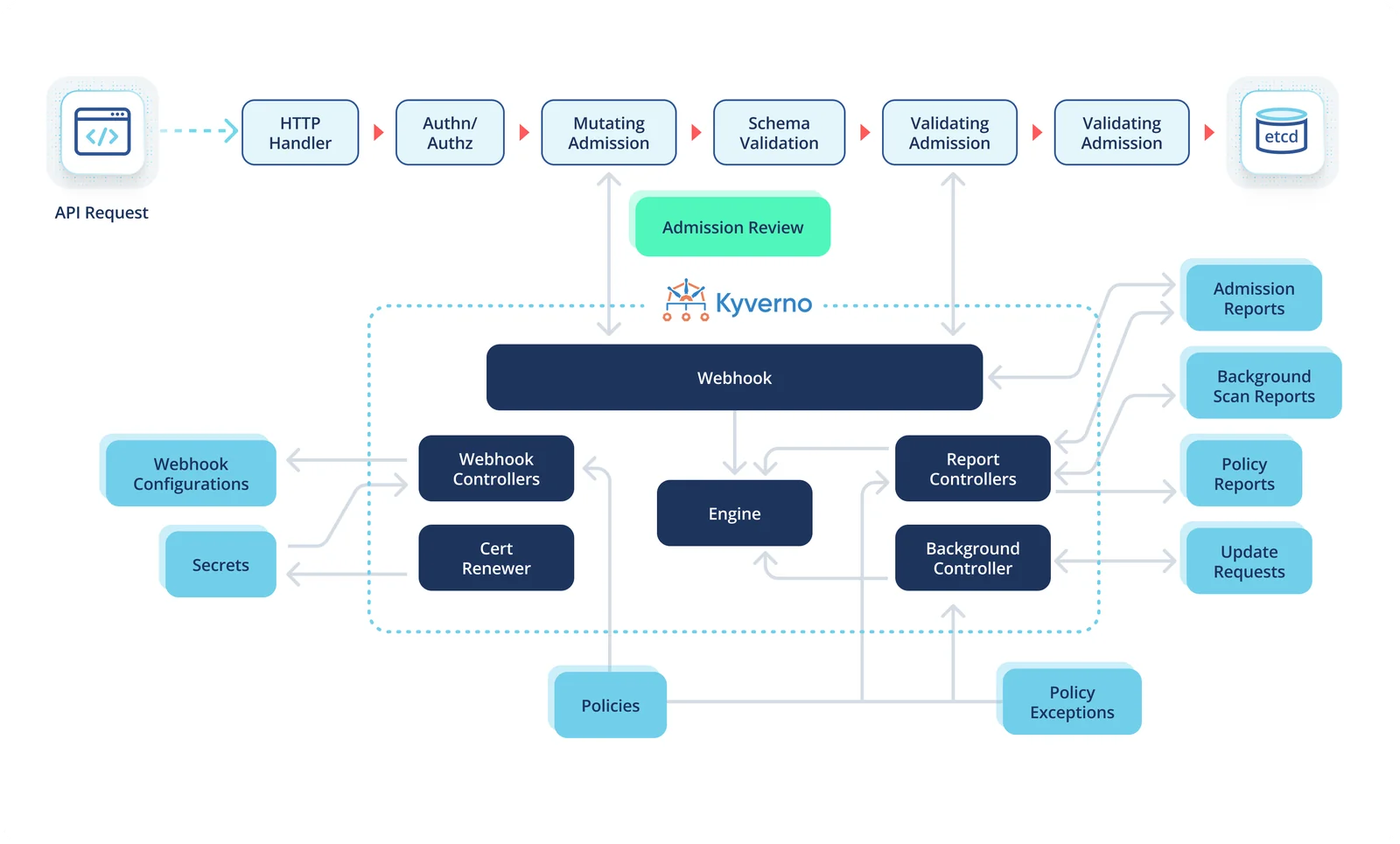
Kyverno is an open-source, Kubernetes-native policy engine designed to simplify the management of security, compliance, and operational policies for Kubernetes environments. Developed by Nirmata and now a Cloud Native Computing Foundation (CNCF) project, Kyverno empowers platform engineering, DevOps, and security teams to define and enforce policies using Kubernetes-native resources without the need for external tools or complex programming languages.
Kyverno distinguishes itself by allowing policies to be written in declarative YAML, the same format used for defining Kubernetes resources. This eliminates the need to learn specialized policy languages like Rego, used by Open Policy Agent (OPA), making it accessible to Kubernetes users of all skill levels. Kyverno seamlessly integrates into Kubernetes workflows, providing native support for Custom Resource Definitions (CRDs) and Kubernetes Admission Controllers.
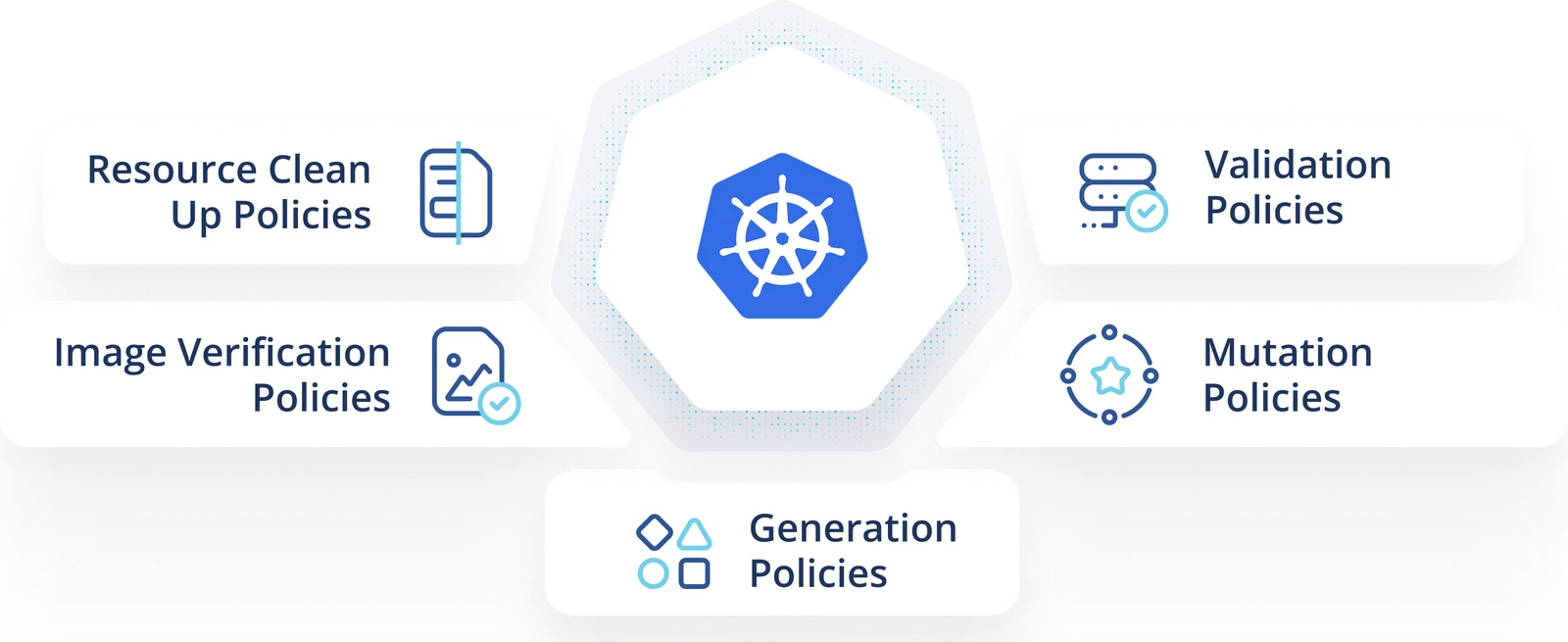
Kyverno’s core functionalities revolve around three key capabilities:
- Validation: Enforce security, compliance, and operational standards by validating resource configurations.
- Mutation: Automatically modify resource configurations to align with best practices and security requirements.
- Generation: Dynamically create or clone Kubernetes resources to automate repetitive tasks and ensure environment consistency.
- Image Verification: Check container image signatures and attestations for software supply chain security.
- Resource Clean Up: Clean up unused resources periodically or based on specific criteria.
By leveraging Kyverno, organizations can operationalize Policy-as-Code (PaC) practices, automate compliance, and enforce security controls across Kubernetes clusters without disrupting developer workflows.
1.2 Key Features of Kyverno
Kyverno offers a comprehensive set of features that streamline Kubernetes policy management:
1.2.1 Validation Policies
Kyverno enables proactive enforcement of security and operational policies by validating Kubernetes resources at admission and runtime. Validation policies ensure workloads adhere to security guidelines, such as restricting privilege escalation, enforcing resource quotas, or requiring specific labels.
Example: Preventing containers from running as root users.
1.2.2 Mutation Policies
Kyverno can automatically modify resource configurations to align with security or operational best practices. Mutation policies allow teams to inject sidecars, set default labels, or configure security contexts without developer intervention.
Example: Automatically adding environment-specific labels to all deployed resources.
1.2.3 Generation Policies
Kyverno’s generation capability automates resource creation, reducing manual overhead and ensuring consistency across environments. It can clone existing resources or dynamically generate new ones when specific triggers occur.
Example: Automatically creating network policies and secrets when a new namespace is provisioned.
1.2.4 Image Verification Policies
Kyverno can check container image signatures and attestations to ensure only verified images can be deployed. A verifyImages rule contains a list of attestors or authorities used to check the attached image signature. The type of attestor supported can vary based on the tool used to sign the image.
Example: Verify a container image signed using Sigstore Cosign using the public key.
1.2.5 Image Verification Policies
Kyverno can automatically clean up (i.e., delete) existing resources in a cluster in two different ways. The first way is via a declarative policy definition and the second way is via a reserved time-to-live (TTL) label added to a resource.
Example: Automatically remove Deployments which have the label can remove: "true" if they have less than two replicas on a schedule of every 5 minutes.
1.2.6 Policy Reports
Kyverno generates detailed policy reports to provide visibility into compliance status and policy violations. These reports can be integrated with monitoring tools like Prometheus, Grafana, and Policy Reporter for real-time insights and proactive remediation.
Example: Reporting all workloads that violate Pod Security Standards (PSS).
1.2.7 Kubernetes-Native Experience
Kyverno is designed to feel native to Kubernetes, embracing its declarative and resource-centric approach. Policies are deployed as standard Kubernetes resources, making Kyverno intuitive for Kubernetes users.
Example: Policies are defined using Kubernetes CRDs, just like Deployments or Services.
1.2.8 JMESPath and CEL Support
Kyverno supports JMESPath and CEL expressions for advanced data filtering and manipulation within policies, enabling powerful and dynamic policy logic without complex scripting.
Example: Ensuring unique ingress hostnames by querying existing resources.
1.3 Why Kyverno for Production Environments?
Deploying Kubernetes at scale introduces complex security, compliance, and operational challenges. Traditional policy management tools often fail to address these challenges in Kubernetes-native ways. Kyverno is purpose-built to solve these problems by providing a simple, scalable, and effective policy management solution tailored for Kubernetes.
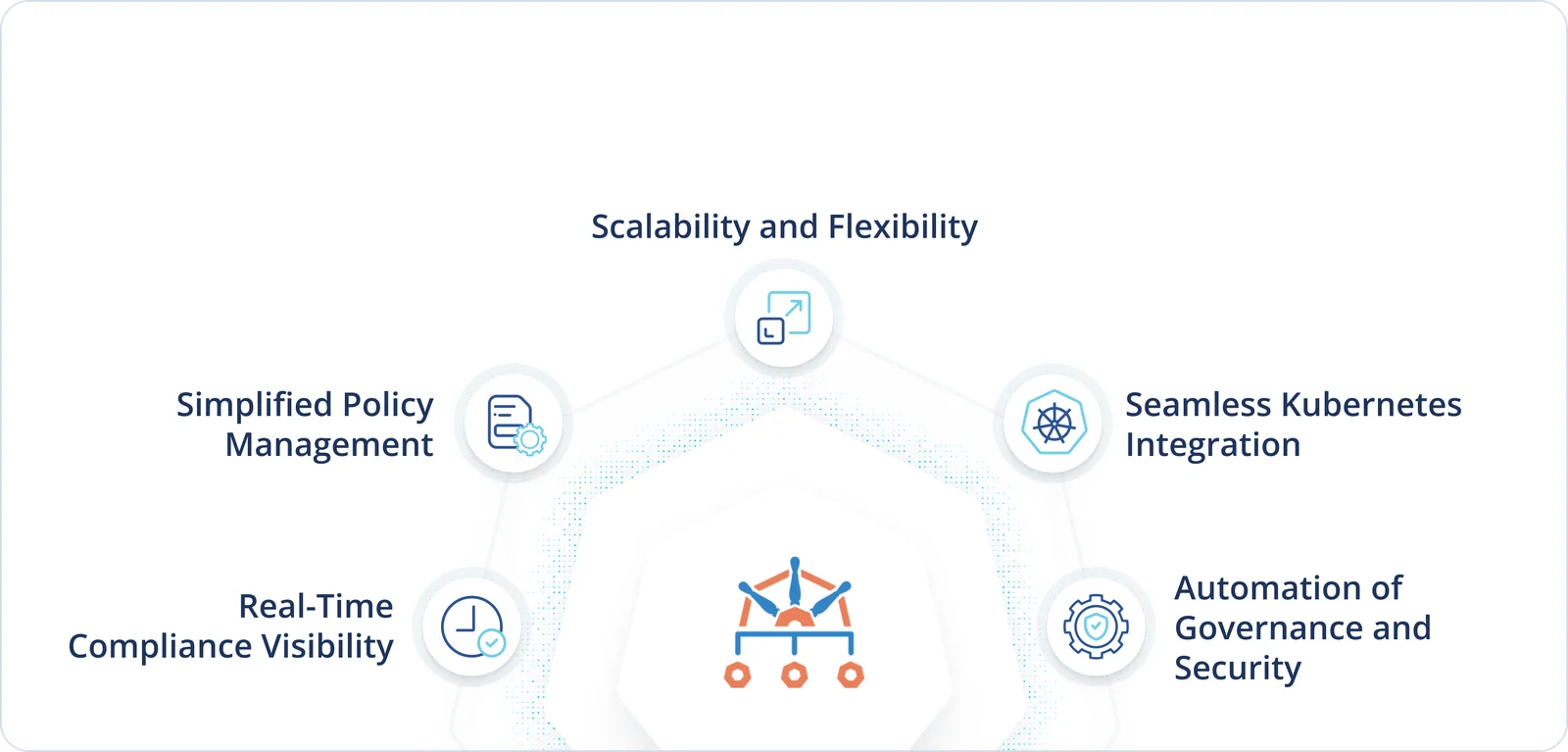
1.3.1 Simplified Policy Management
Kyverno eliminates the need to learn complex policy languages by allowing policies to be defined using YAML, which is familiar to Kubernetes users. This lowers the learning curve and accelerates policy adoption across teams.
1.3.2 Seamless Kubernetes Integration
As a Kubernetes-native solution, Kyverno integrates directly with Kubernetes admission controllers, Custom Resource Definitions (CRDs), and resource schemas. This ensures minimal disruption to existing workflows and offers consistent policy enforcement.
1.3.3 Automation of Governance and Security
Kyverno automates routine security and compliance tasks, reducing manual interventions and human errors. Teams can implement proactive security controls and enforce best practices across development, testing, and production environments.
1.3.4 Scalability and Flexibility
Kyverno is designed to scale across multiple clusters and environments. Its ability to automate policy deployment, handle exceptions, and integrate with CI/CD pipelines makes it ideal for large-scale production environments.
1.3.5 Real-Time Compliance Visibility
Kyverno provides actionable insights through policy reports and monitoring integrations, enabling continuous compliance and proactive remediation. This visibility is critical for meeting regulatory requirements and internal security standards.
Summary
Kyverno’s Kubernetes-native design, combined with its powerful validation, mutation, and generation capabilities, makes it an essential tool for organizations seeking to secure and automate their Kubernetes environments at scale.
Chapter 2
Preparing for Kyverno Deployment
Successfully deploying Kyverno in a production environment requires careful planning and consideration of the Kubernetes infrastructure, security configurations, and operational workflows. This section outlines the best practices for preparing your environment for a scalable, secure, and high-performing Kyverno deployment.
2.1 Infrastructure and Environment Readiness
Before deploying Kyverno, it’s essential to ensure that the Kubernetes environment meets the necessary requirements for stable operation.
2.1.1 Kubernetes Version Compatibility
Kyverno supports Kubernetes versions 1.16 and above. However, for production deployments, it’s recommended to use Kubernetes 1.21+ to leverage advanced features and performance optimizations.
- Compatibility Matrix: Kyverno Documentation – Installation
2.1.2 Custom Resource Definitions (CRDs)
Kyverno relies on Kubernetes Custom Resource Definitions (CRDs) for defining policies. Ensure your cluster allows CRD creation and management. Kyverno automatically installs the required CRDs during setup.
2.1.3 Admission Controllers
Kyverno integrates with Kubernetes admission controllers using mutating and validating webhooks. Ensure these admission controllers are enabled in your cluster:
--enable-admission-plugins=MutatingAdmissionWebhook,ValidatingAdmissionWebhook\- Kubernetes Admission Controllers: Kubernetes Docs – Admission Controllers
2.1.4 Resource Sizing and Scaling
Proper resource allocation ensures Kyverno performs efficiently, especially in large or high-traffic clusters.
- Default Resource Requests:
- CPU: 100m
- Memory: 256Mi
- Production Recommendation:
- Scale based on policy complexity and cluster workload.
- Allocate more CPU/memory for large-scale or multi-cluster deployments.
2.1.5 High Availability Setup
For production, Kyverno should run in High Availability (HA) mode to ensure continuous policy enforcement during node failures or upgrades.
2.2 Installation Best Practices
Kyverno supports multiple installation methods. For production, using Helm or GitOps tools ensures repeatable and controlled deployments.
2.2.1 Installing Kyverno via Helm (Recommended)
- Add the Kyverno Helm Repository:
helm repo add kyverno https://kyverno.github.io/kyverno/ helm repo update - Install Kyverno with Custom Configurations:
helm install kyverno kyverno/kyverno --namespace kyverno --create-namespace - Verify Installation:
kubectl get pods -n kyverno
Helm Installation Guide: Kyverno Documentation – Install with Helm
2.2.2 Certificate Management for Webhooks
Kyverno uses TLS certificates for securing webhook communication with the Kubernetes API server. In production:
- Use default (self-signed) or Custom certificates (own CA-signed or self-signed). Kubernetes Secret is used to store the certificates.
- Rotate certificates regularly to avoid downtime. Kyverno performs certificate validity checks when events occur on secrets containing the managed certificates.
Certificate Management Guide: Configuring Kyverno Certificates
2.2.3 Namespace and RBAC Configuration
- Deploy Kyverno in a dedicated namespace (kyverno) to isolate it from other workloads.
- Implement Role-Based Access Control (RBAC) with the principle of least privilege for Kyverno components.
apiVersion: rbac.authorization.k8s.io/v1
kind: ClusterRoleBinding
metadata:
  name: kyverno-rolebinding
roleRef:
  apiGroup: rbac.authorization.k8s.io
  kind: ClusterRole
  name: kyverno
subjects:
  - kind: ServiceAccount
    name: kyverno-service-account
namespace: kyverno- RBAC Configuration Guide: Configuring Kyverno RBAC
2.3 Policy Lifecycle Management
Implementing a robust policy lifecycle process is critical for maintaining consistency and security across Kubernetes clusters.
2.3.1 Organizing Policy Repositories (GitOps Integration)
Adopt GitOps principles for policy management. Store policies in version-controlled repositories and automate deployments using tools like Argo CD or Flux.
- Kyverno GitOps Guide: Kyverno GitOps Integration
2.3.2 Namespace and RBAC Configuration
Use the Kyverno CLI to test policies before applying them in production.
- Install Kyverno CLI:
brew install kyverno - Test Policy Validation:
kyverno apply policy.yaml --resource resource.yaml - Automate Tests in CI/CD Pipelines to catch policy issues early.
- Policy Testing Guide: Kyverno CLI
2.3.3 Versioning and Auditing Policies
- Tag and version policy files in Git respositories.
- Use policy reports for auditing and compliance tracking.
- Example Directory Structure:
/policies
  ├── security
  │   ├── restrict-root.yaml
  │   └── enforce-image-signing.yaml
  ├── network
  │   └── default-deny.yaml
  └── compliance
      └── cis-benchmark.yaml
Summary
Proper preparation is critical for a successful Kyverno deployment in production. By ensuring Kubernetes readiness, following secure installation practices, managing policies through GitOps, and scaling for performance, organizations can fully leverage Kyverno’s capabilities for automated security, compliance, and operational governance.
Chapter 3
Writing Effective Kyverno Policies
Effective policy design is crucial for securing Kubernetes clusters, enforcing best practices, and automating governance. Kyverno simplifies this process by allowing policies to be defined using declarative YAML, making it accessible for Kubernetes users without requiring knowledge of complex programming languages like Rego.
This section provides best practices for writing, organizing, and managing Kyverno policies to ensure they are effective, scalable, and easy to maintain.
3.1 Policy Design Principles
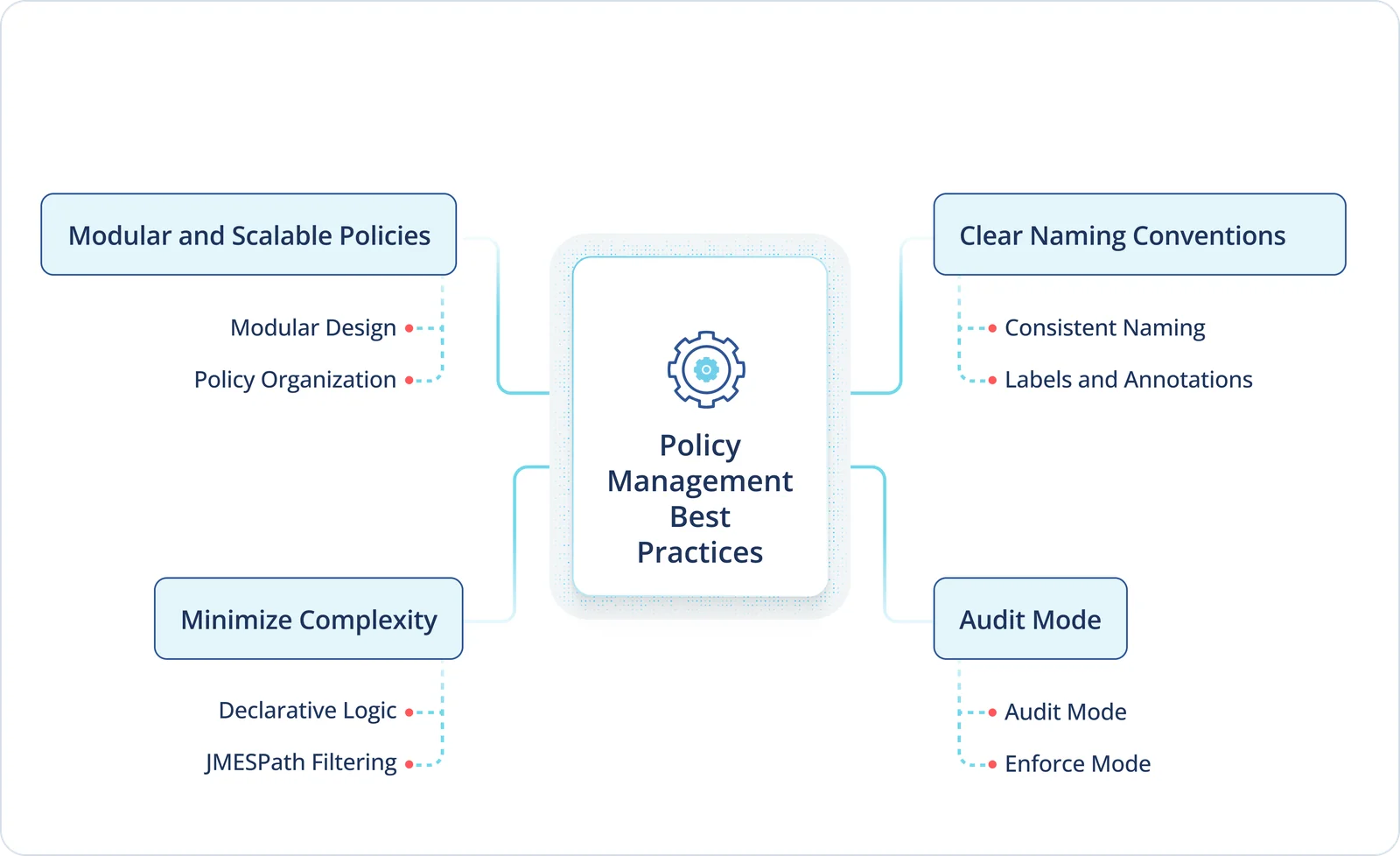
3.1.1 Keep Policies Modular and Scalable
- Modular Design: Break own complex policies into smaller, reusable components. This improves readability and maintainability.
- Policy Organization: Group related rules under a single policy and separate distinct functionalities into different policies.
Example Directory Structure:
/policies
  ├── security
  │   ├── restrict-root.yaml
  │   └── enforce-image-signing.yaml
  ├── network
  │   └── default-deny.yaml
  └── compliance
      └── cis-benchmark.yaml
3.1.2 Use Clear Naming Conventions and Labels
- Adopt consistent naming conventions for policies.
- Use labels and annotations to describe, categorize and manage policies.
Example Policy Metadata:
metadata:
  name: restrict-root-user
  labels:
    app: kyverno
    category: security
  annotations:
    policies.kyverno.io/category: Security
    policies.kyverno.io/severity: high
    policies.kyverno.io/description: >-
      Disallow containers from running as root.
3.1.3 Start with Audit Mode
- Apply new policies in audit mode (enforce: audit) to monitor potential violations without impacting workloads.
- Once validated, switch to enforce mode (enforce: enforce) for strict enforcement.
spec:
  validationFailureAction: Audit
3.1.4 Minimize Policy Complexity
- Use simple, declarative logic wherever possible.
- Avoid overly complex rules that may increase admission latency.
- Leverage JMESPath for efficient data filtering.
3.2 Policy Testing and Validation
3.2.1 Use Kyverno CLI for Testing
Test policies against resource manifests before deployment.
kyverno apply policies/ --resource resources/Kyverno CLI: User Guide
3.2.2 Integrate with CI/CD Pipelines
Automate policy testing in CI/CD pipelines to catch violations early.
- GitHub Actions: Kyverno GitHub Actions
- Test Policy Validation: Kyverno CI/CD Integration
3.2.3 Dry Run Mode
Validate policy syntax without applying it to the cluster.
kubectl apply -f policy.yaml --server-dry-runApply policy to all matching resources in a cluster based on the current kubectl context.
kyverno apply /path/to/policy.yaml --clusterSummary
Writing effective Kyverno policies involves balancing security, compliance, and operational efficiency. By following best practices—such as modular policy design, leveraging validate/mutate/generate capabilities, and integrating policy testing—teams can secure Kubernetes environments while enabling automation and scalability.
For more examples and templates, explore the Kyverno Policy Library:
Chapter 4
Observability
Observability is critical for ensuring the health, performance, and reliability of Kyverno in production environments. It enables platform teams to monitor Kyverno controllers, policies, and events, identify potential issues early, and maintain effective policy enforcement across clusters.
4.1 Key Components of Observability
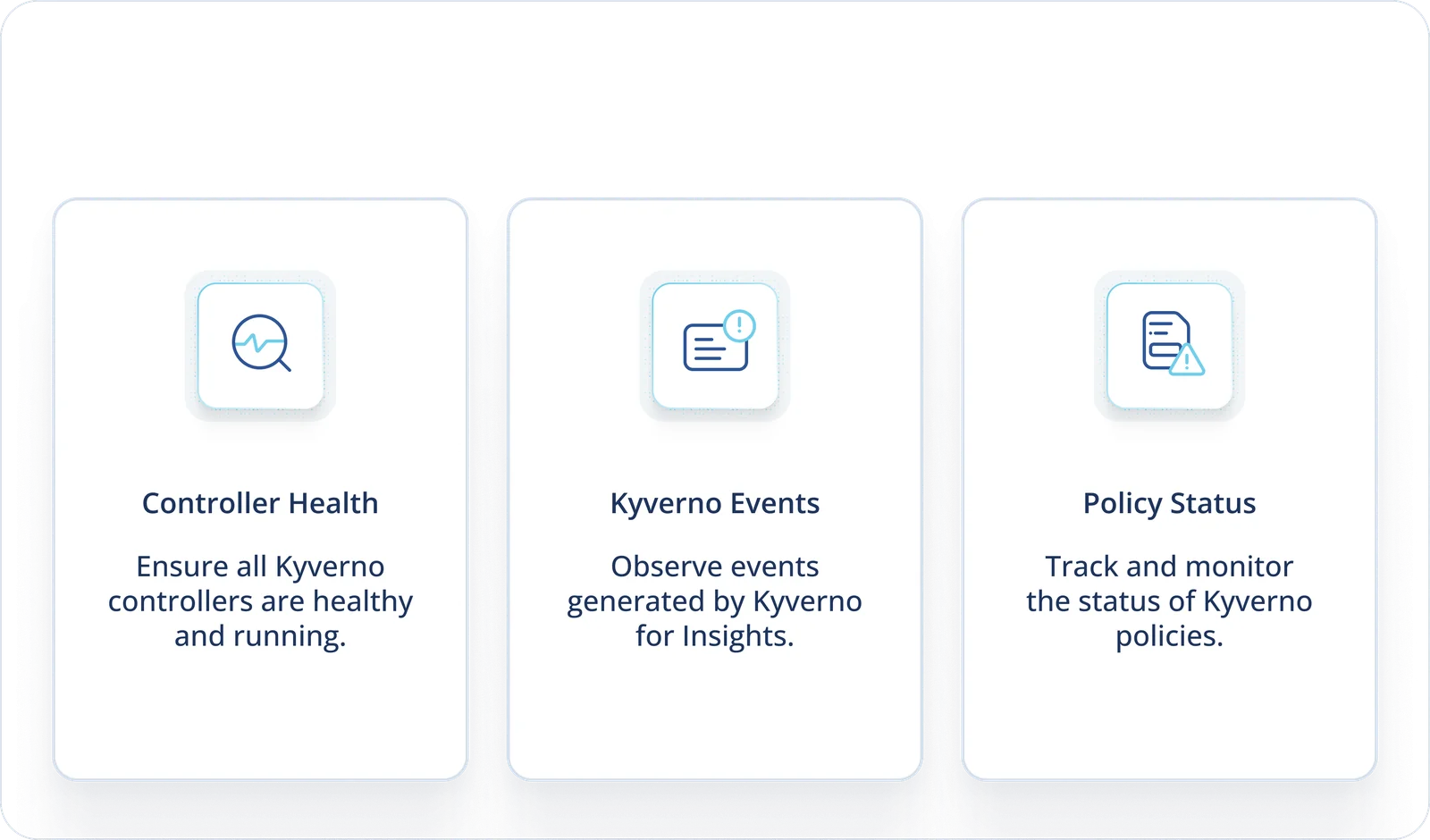
4.1.1 Kyverno Controller Health
Status: Ensure all Kyverno controllers (e.g., webhook, background, and report controllers) are running and healthy.
Metrics: Monitor critical performance metrics, including:
- Admission request processing latency.
- Memory and CPU usage of Kyverno pods.
- Logs: Use Kyverno logs to debug policy enforcement and webhook issues.
4.1.2 Kyverno Policy Status
- Track the status of each policy to ensure enforcement is active and functioning as expected.
- Monitor policy errors that may prevent enforcement or cause violations.
4.1.3 Kyverno Events
- Observe events generated by Kyverno, including:
- Admission decisions.
- Policy violation reports.
- Resource mutation or generation actions.
4.2 Tools for Observability
4.2.1 Grafana Dashboard
Kyverno integrates with Prometheus and Grafana for visualizing policy performance and cluster metrics. The Grafana dashboard provides real-time insights into:
- Policy violations.
- Rule execution latency.
- Admission webhook performance.
Set Up the Grafana Dashboard: Grafana Dashboard Guide
4.2.2 OpenTelemetry
Kyverno supports OpenTelemetry for exporting metrics and spans. This allows platform teams to monitor:
- Policy execution traces.
- Admission request flows.
- Webhook interactions.
OpenTelemetry Benefits:
- Granular visibility into policy enforcement behavior.
- Integration with advanced observability platforms.
4.2.3 Policy Reporter
Policy Reporter collects and visualizes Kyverno policy violations and compliance data. Key features include:
- A web-based dashboard for centralized visibility.
- Alerts to external systems (e.g., Slack, Discord, webhooks).
Learn More: Policy Reporter Documentation
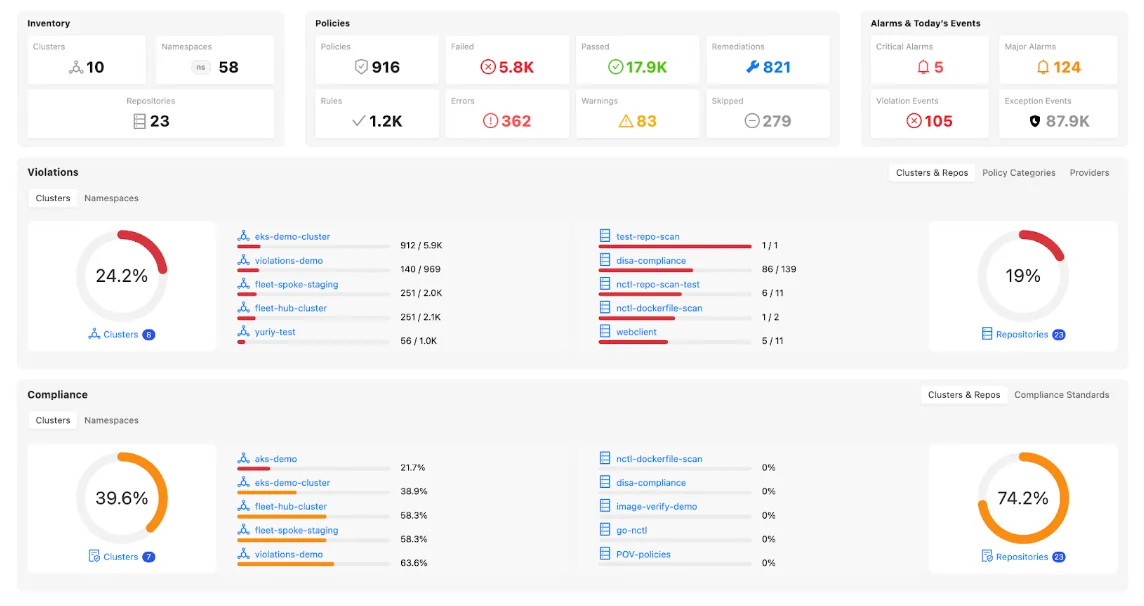
4.2.4 Advanced Observability with Nirmata Control Hub
Nirmata Control Hub extends Kyverno’s capabilities with centralized monitoring and advanced analytics. It provides:
- A single pane of glass for managing policies across clusters.
- Real-time policy compliance reports and trends.
- Seamless integration with Kyverno’s event and metrics data.
Benefits of Nirmata Control Hub:
- Simplifies multi-cluster observability.
- Enhances compliance tracking and remediation.
- Offers proactive alerts for potential policy violations.
Learn More: Nirmata Control Hub
Summary
Robust observability is essential for maintaining the health and performance of Kyverno in production. By leveraging tools like Grafana, OpenTelemetry, and Nirmata Control Hub, platform teams can gain real-time insights into policy enforcement and ensure their Kubernetes environments remain secure and compliant.
Chapter 5
Availability
Kyverno validation policies are configured to run in a “fail-closed” mode by default to prioritize security. This means that if the Kubernetes API server cannot reach Kyverno, cluster operations will be blocked. While this ensures secure operations, it also requires careful configuration and management of Kyverno controllers and policies to avoid operational bottlenecks.
5.1 Key Considerations for Availability
- Fail-Closed Mode:
- The fail-closed mode ensures that requests are denied when Kyverno is unreachable, preventing insecure configurations from being applied.
- Risk: If not configured correctly, this can lead to cluster disruptions.
- Mitigation: Ensure proper scaling and resource allocation for Kyverno controllers.Memory and CPU usage of Kyverno pods.
- Highly Configurable Policies:
- Kyverno and its policies provide flexible configurations to enable smooth operations, even in high-demand environments.
- Tuning policy and webhook settings is essential for ensuring availability without compromising performance.
5.2 Best Practices for Availability
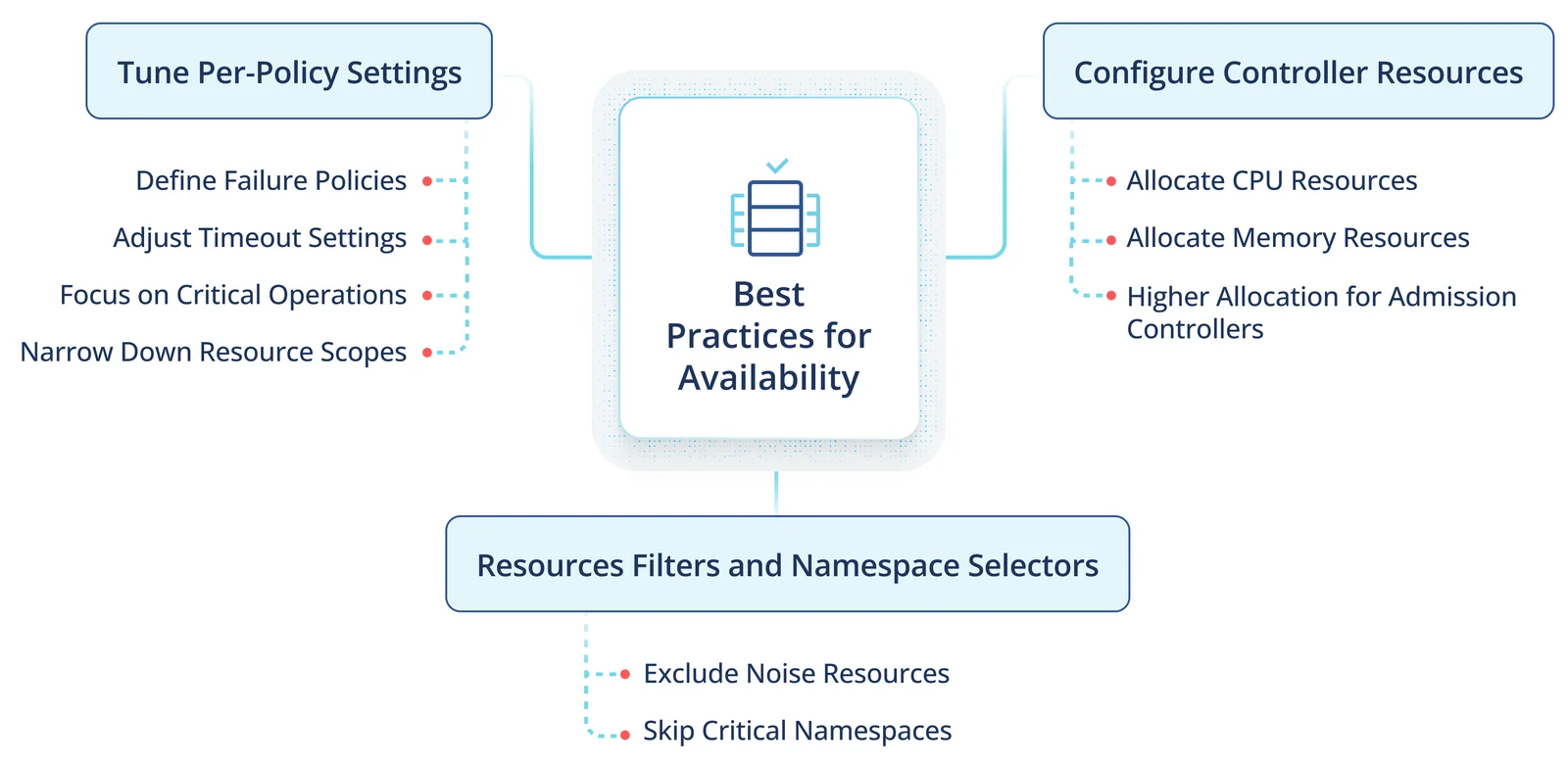
5.2.1 Use Resource Filters and Namespace Selectors
- Resource Filters: Exclude specific noisy resources (e.g., events, status updates) from webhook requests to reduce unnecessary load on Kyverno.
- Namespace Selectors: Configure namespace selectors to skip critical namespaces like:
- Kube-system
- CNIs (e.g., Calico, Cilium)
- Monitoring tools
5.2.2 Tune Per-Policy Settings
- failurePolicy: Define how policies handle failures (e.g., Fail, Ignore).
- webhookTimeoutSeconds: Adjust timeout settings to prevent request drops during high loads.
- match.operations: Focus on critical admission operations (e.g., CREATE, UPDATE) for optimized processing.
- webhookConfiguration.matchExpressions: Use match expressions to narrow down resource scopes.
5.2.3 Configure Controller Resources
- Allocate appropriate CPU and memory resources for each controller to handle workloads efficiently.
- Admission controllers require higher resource allocations due to real-time request processing.
5.3 Disaster Recovery
Store Kyverno policies in Git repositories for version control and disaster recovery. Use GitOps tools such as ArgoCD or Flux to redeploy policies when needed.
Summary
Ensuring Kyverno’s availability in production environments requires proactive configuration and scaling of its components. By leveraging resource filters, namespace selectors, and optimized policy settings, platform teams can prevent unnecessary webhook traffic and ensure seamless policy enforcement.
Key Recommendations for Availability:
- Configure fail-closed policies carefully to prevent unnecessary disruptions.
- Scale critical controllers like the Admission Controller with multiple replicas.
- Use resource filters, namespace selectors, and webhook settings to minimize operational overhead.
- Monitor health and performance with observability tools like Prometheus and Grafana.
Chapter 6
Scaling Kyverno
Scaling Kyverno effectively is critical for ensuring that policy enforcement, admission requests, and background processing remain performant in high-load Kubernetes environments. While larger clusters can often be managed with proper resource allocation, busy clusters with a high volume of admission requests pose unique challenges.
The load on Kyverno is determined by the product of:
- The number of rules being enforced.
- The number of admission requests per second (ARPS).
Key metrics to monitor include ARPS and policy rule execution latency.
6.1 Scaling Kyverno Components
Kyverno components are highly configurable to support diverse workloads and ensure availability in production. The following table outlines the scaling strategies for Kyverno controllers:
| Controller | Handles Webhooks? | Scaling Strategy |
|---|---|---|
| Admission Controller | Yes | Scale-up and scale-out with multiple replicas (minimum 3). |
| Reports Controller | No | Scale-up; leader instance performs all work. |
| Background Controller | No | Scale-up; leader instance performs all work. |
| Cleanup Controller | Yes | Scale-up and scale-out with multiple replicas. |
6.2 Best Practices for Scaling Kyverno
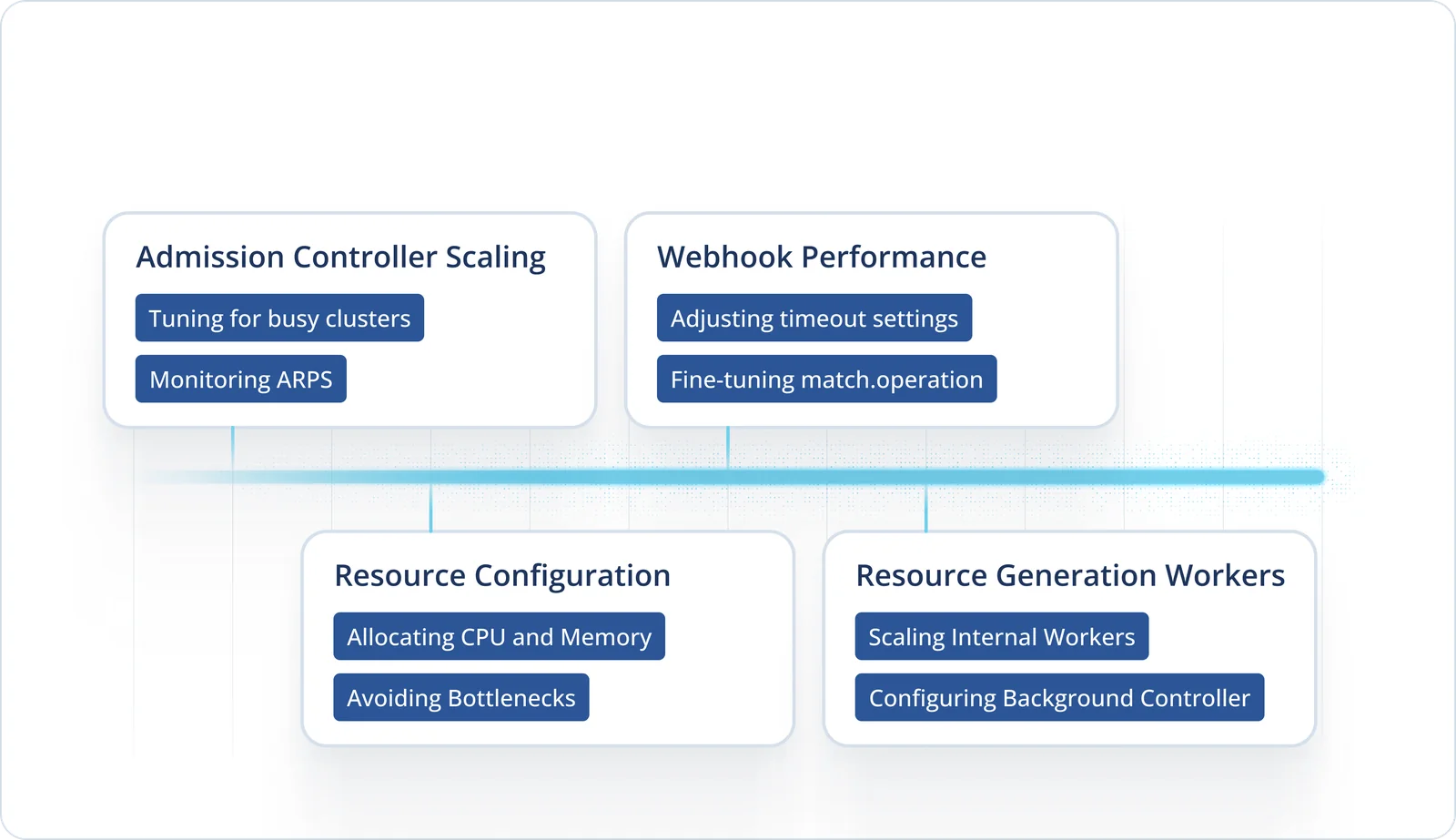
6.2.1 Admission Controller Setting
- Scale the admission controller and reports controller to handle increasing workloads effectively.
- Busy clusters require tuning to avoid bottlenecks and ensure consistent policy enforcement.
Tips for Admission Controller Scaling:
- Use at least three replicas for high availability.
- Monitor ARPS and ensure the admission controller is not overwhelmed by requests.
Tips for Reports Controller Scaling:
- Operates with a leader instance. Scale-up the resources for this controller in large or active clusters.
6.2.2 Resource Configuration
Allocate appropriate CPU and memory for each controller to avoid bottlenecks.
- Admission Controller: Requires higher resource allocation for real-time decision-making.
- Background and Cleanup Controllers: Scale-up to handle heavy workloads efficiently.
6.2.3 Optimize Webhook Performance
- Fine-tune match.operations to target only relevant admission operations (e.g., CREATE, UPDATE).
- Use webhookConfiguration.matchExpressions to narrow down resource scope for webhooks.
6.2.4 Optimize Webhook Timeout Settings
The Kubernetes API server communicates with Kyverno through mutating and validating webhooks.
Tuning webhook configurations prevents bottlenecks.
- Default Timeout: 3 seconds
- Recommended Adjustment for High Load Clusters:
helm upgrade kyverno kyverno/kyverno \ --set admissionController.timeoutSeconds=10 - Webhook Configuration: Kubernetes Webhook Docs
6.2.5 Scaling Resource Generation Workers
Kyverno Background Controller is responsible for handling of generate and mutate-existing rules.In high-activity clusters, vertical scaling of the replicas can be performed by increasing the number of internal workers used by these processes.
- Default Resource Generation Workers: 10
- Background Controller Configuration: Resource Generation Workers
helm upgrade kyverno kyverno/kyverno \
  --set admissionController.timeoutSeconds=10
6.2.6 Disable Unused Controllers
- Turn Off Controllers That Are Not Used:
- Disable controllers such as reporting, background processing, or cleanup if they are not required for your use case.
- Reducing unused controllers minimizes resource consumption and operational overhead.
6.2.7 Tuning Event Processing Per Controller
- Optimize the number of events handled by each controller to align with cluster activity.
- Turn off event reporting for policies or namespaces where it is unnecessary to reduce workload.
6.2.8 Policy Reporting and Background Processing
- Optimize Per-Policy Reporting:
- Reduce the scope of policies that trigger reports.
- Set validationFailureAction: audit for policies in non-critical namespaces.
- Tune Background Processing:
- Limit the frequency of background policy checks for non-essential workloads.
6.2.9 Avoid Throttling by Tuning Client Rate Limits
To avoid throttling Kyverno’s API server requests, adjust the clientRateLimitBurst and clientRateLimitQPS settings.
6.2.10 Leverage Caching for Performance
Kyverno uses caching to reduce the frequency of API calls, which improves performance in busy clusters.
- Policy Caching: Policies are cached by default, ensuring faster lookup and execution.
- ConfigMap Caching: Use labels to cache frequently accessed ConfigMaps.
Flexible Resource Caching:
Starting with Kyverno 1.12, flexible resource caching allows internal and external data sources to be cached, enabling faster access to dynamic data.
6.3 Key Metrics to Monitor
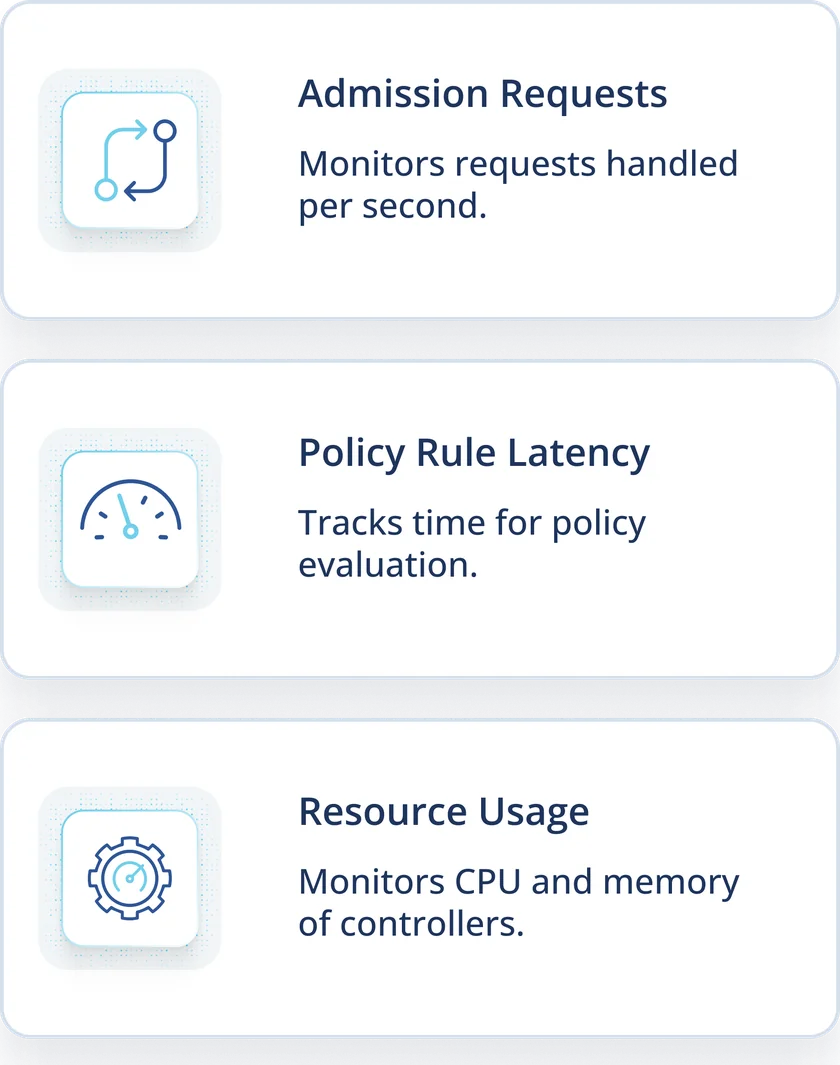
6.3.1 Admission Requests Per Second (ARPS):
- Monitors how many admission requests are handled by Kyverno per second.
- High ARPS may require scaling or tuning to avoid delays.
6.3.2 Policy Rule Execution Latency:
- Tracks the time taken to evaluate and enforce policy rules.
- Optimize policies and enable caching to reduce latency.
6.3.3 Controller Resource Usage:
- Monitor CPU and memory usage of each Kyverno controller.
6.4 Multi-Cluster Kyverno Management
6.4.1 Centralized Policy Management
For multi-cluster environments, manage Kyverno policies centrally using Nirmata Control Hub
- Nirmata Control Hub: A unified platform for automating security operations at scale using policy-as-code.
6.4.2 Policy Distribution Across Clusters
Use GitOps tools like ArgoCD, Flux or Nirmata Control Hub to deploy Kyverno policies across multiple clusters.
- Fleet Docs: Rancher Fleet
- OCM Docs: Open Cluster Management
- Nirmata Control Hub: Nirmata Control Hub Policy Sets
Summary
Scaling Kyverno in production requires proactive performance tuning, high availability configurations, comprehensive monitoring, and reliable backup strategies. By implementing the best practices outlined in this section, organizations can ensure that Kyverno operates efficiently and securely across Kubernetes clusters, delivering consistent policy enforcement at scale.
Key Recommendations for Scalability:
- Scale admission controllers with multiple replicas for availability.
- Optimize resource allocation for all controllers based on workload demands.
- Use filters, namespace selectors, and fine-tuned webhook configurations to reduce unnecessary overhead.
Chapter 7
Integrations and Ecosystem
Kyverno seamlessly integrates with various tools and platforms across the Kubernetes ecosystem to provide comprehensive security, compliance, and automation. These integrations enhance policy deployment, monitoring, and security posture management, enabling organizations to scale and secure Kubernetes operations efficiently.
This section explores how Kyverno integrates with GitOps tools, monitoring and observability platforms, and cloud-native security solutions.This section explores how Kyverno integrates with GitOps tools, monitoring and observability platforms, and cloud-native security solutions.
7.1 Kyverno with GitOps Tools
GitOps is a declarative approach to infrastructure and application management where Git repositories act as the single source of truth. Kyverno integrates with popular GitOps tools like ArgoCD and Flux to automate policy deployment and enforcement across Kubernetes clusters.
7.1.1 ArgoCD Integration for Policy Deployment
ArgoCD is a declarative, GitOps continuous delivery tool for Kubernetes. Kyverno policies can be managed in Git repositories and automatically deployed to clusters using ArgoCD, ensuring consistent security and compliance enforcement.
Best Practices:
- Store Kyverno policies in a Git repository.
- Automate policy deployment and updates using ArgoCD.
Learn More:
7.1.2 Flux Integration for Continuous Policy Enforcement
Flux is a Kubernetes-native GitOps tool for continuous deployment. Kyverno policies stored in Git repositories can be automatically synced to clusters using Flux, ensuring real-time enforcement of security policies.
Best Practices:
- Use Flux for continuous synchronization of Kyverno policies.
- Leverage Flux’s reconciliation loops to detect and fix drift in policy enforcement.
Learn More:
7.2 Monitoring and Observability Tools
Monitoring Kyverno’s performance and policy enforcement status is critical for maintaining security and compliance in Kubernetes environments. Kyverno integrates with leading observability tools like Policy Reporter, Prometheus, and Grafana for real-time visibility.
7.2.1 Policy Reporter for Policy Compliance Visibility
Policy Reporter is a dedicated observability tool for Kyverno that visualizes policy violations and compliance reports. It collects and displays Kyverno’s policy reports in a web-based dashboard and can forward events to external systems.
Features:
- Visual dashboard for policy reports.
- Integration with Prometheus, Grafana, and Elasticsearch.
- Alerting to Slack, Discord, and webhooks.
Learn More:
7.2.2 Prometheus and Grafana for Metrics and Dashboards
Kyverno exposes performance and policy metrics that can be scraped by Prometheus and visualized with Grafana. This provides real-time monitoring of policy enforcement and cluster security posture.
Learn More:
7.3 Security and Compliance Tools
Kyverno integrates with cloud-native security platforms to enhance Kubernetes security and compliance. These integrations help bridge policy enforcement with vulnerability management and cloud security posture management (CSPM).
7.3.1 Integration with Wiz for Cloud Security Posture Management (CSPM)
Wiz is a cloud-native security platform that provides visibility into cloud infrastructure risks. Integrating Kyverno with Wiz allows teams to:
- Align Kubernetes policy enforcement with cloud security posture management.
- Detect and remediate misconfigurations and vulnerabilities across cloud workloads.
Learn More:
7.3.2 Integration with Prisma Cloud for Kubernetes Security
Prisma Cloud by Palo Alto Networks provides comprehensive security for cloud-native applications. Integrating Kyverno with Prisma Cloud enhances Kubernetes security by:
- Enforcing runtime security policies alongside infrastructure security controls.
- Aligning Kyverno policies with broader cloud security standards.
Learn More:
7.3.3 Integration with Kyverno-Compatible CNAPP Solutions
Kyverno can complement Cloud-Native Application Protection Platforms (CNAPPs) by providing policy-as-code capabilities that integrate with runtime security solutions.
Key Benefits:
- Consistent policy enforcement across CI/CD pipelines and runtime environments.
- Integration with vulnerability scanners and compliance tools.
Summary
Kyverno’s integrations with GitOps, monitoring, and security platforms strengthen Kubernetes security and governance by automating policy deployment, improving observability, and aligning with cloud security solutions.
Key Integrations in Production:
- GitOps: Automate policy deployment with ArgoCD and Flux.
- Observability: Gain real-time insights with Policy Reporter, Prometheus, and Grafana.
- Security Platforms: Strengthen cloud security with Wiz, Prisma Cloud, and CNAPP solutions.
Chapter 8
Conclusion
8.1 Recap of Kyverno’s Value in Production Environments
Kyverno delivers a powerful, Kubernetes-native solution for automating security, compliance, and operational governance at scale. Its declarative policy-as-code model simplifies policy management, making it accessible to Kubernetes users without requiring complex programming knowledge.
Kyverno’s Key Strengths:
- Simplified Policy Management: Declarative YAML policies for validation, mutation, and generation.
- Security and Compliance: Enforcement of best practices, cloud security controls, and compliance standards (e.g., CIS, NIST).
- Automation and Scalability: Seamless integration with GitOps tools, CI/CD pipelines, and multi-cluster environments.
- Observability: Detailed policy reports and integrations with monitoring tools like Prometheus, Grafana, and Policy Reporter.
8.2 Final Recommendations for Scalable, Secure Policy Management
To maximize Kyverno’s effectiveness in production environments, organizations should follow these best practices:
- Harden Kyverno Deployment: Secure webhooks, apply least privilege RBAC, and isolate Kyverno in a dedicated namespace.
- Optimize Policy Design: Use modular policies, prioritize rules, and minimize complexity to improve performance.
- Integrate with DevOps Workflows: Automate policy deployment with ArgoCD or Flux and enforce security gates in CI/CD pipelines.
- Enhance Observability: Monitor policy enforcement and performance using Prometheus, Grafana, and Policy Reporter.
- Manage Exceptions Responsibly: Implement structured workflows for handling policy exceptions with auditing and time-bound rules.
- Stay Updated with Roadmap Enhancements: Leverage upcoming features like forEach loops, JavaScript extensibility, and enhanced observability.
By adopting Kyverno, organizations can effectively secure Kubernetes environments, automate operations, and achieve continuous compliance at scale.
For more information, visit the official Kyverno resources:
Appendices
Appendix A. Installation Guides
Kyverno can be installed and managed using Helm, the Kubernetes package manager, for simplified deployment and upgrades.
B.1 Install Kyverno with Helm
Appendix B. Troubleshooting Guide
About the Authors
Nirmata is the creator and primary maintainer of Kyverno, a Kubernetes-native policy engine. Nirmata focuses on empowering platform engineering teams with secure and scalable policy management solutions for Kubernetes environments.
Kyverno is a Cloud Native Computing Foundation (CNCF) incubating project with an active and growing community of contributors, adopters, and partners.
Learn More:
References
Kyverno Documentation:
Kubernetes Security Standards:
GitOps Tools:
Policy Management and Observability: